
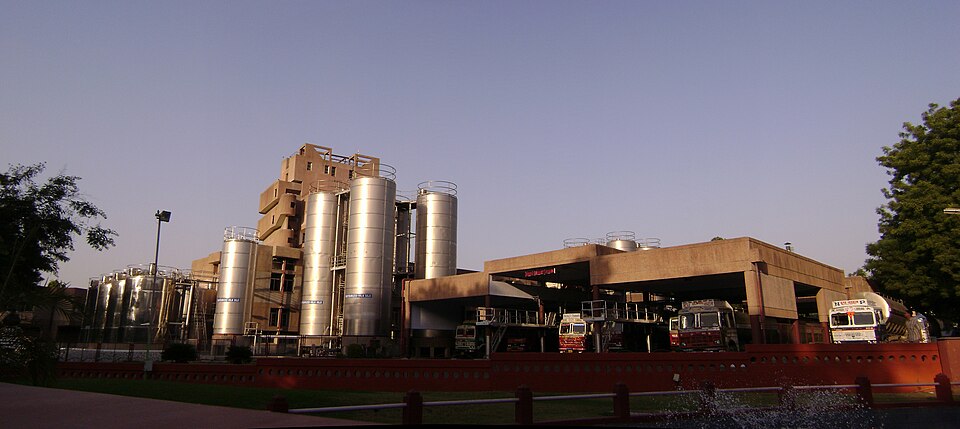

Amul is a brand owned by the Gujarat Cooperative Milk Marketing Federation (GCMMF), which is in turn owned by around 36 lakh dairy farmers in Gujarat. In 2025-26, the Amul brand crossed Rs 1 lakh crore in turnover. This Amul case study explains how a 1946 farmers’ protest in Kaira district became that business.
- Background: how Amul started in Anand
- The problem Amul set out to solve
- Strategy 1: the three-tier Anand pattern
- Strategy 2: Operation Flood took the model national
- Strategy 3: a fair price system for farmers
- Strategy 4: the Amul girl and topical advertising
- Strategy 5: distribution and product range
- Results: Amul's verified numbers
- Key lessons for Indian businesses and students
- Amul quick facts
- Frequently asked questions
Background: how Amul started in Anand
In the 1940s, milk farmers in Kaira district (now Kheda) in Gujarat sold their milk to a private company, Polson, which had an effective monopoly on collecting milk there and supplying it to Bombay. Farmers had little say in the price they were paid.
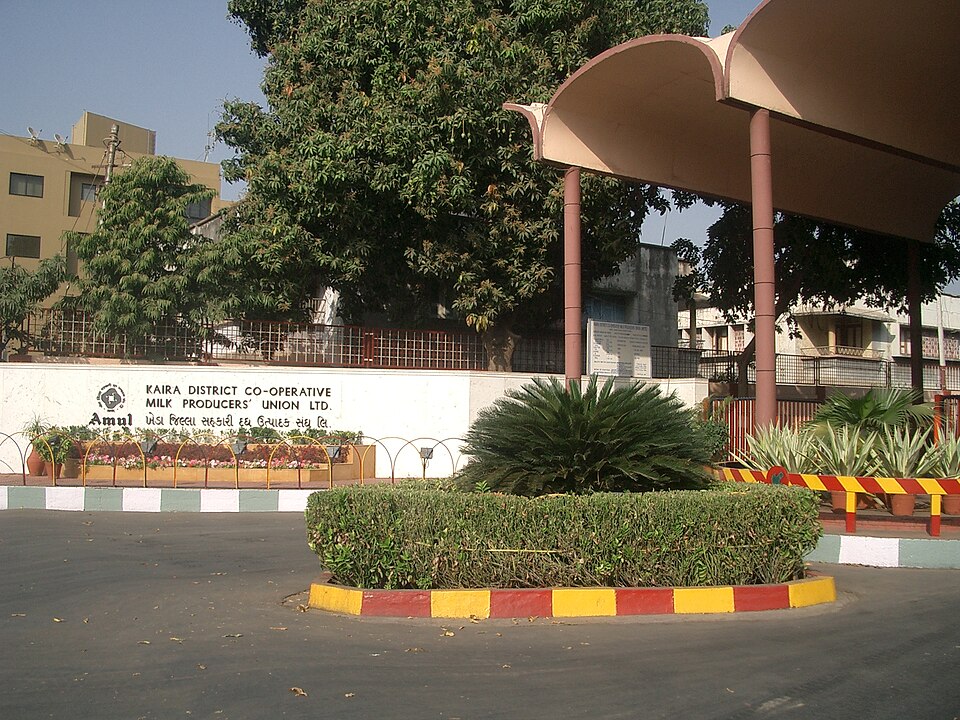
The farmers took their complaint to Sardar Vallabhbhai Patel. He advised them to form their own cooperative and sell directly to the Bombay Milk Scheme, and sent Morarji Desai to help organise them. Local leader Tribhuvandas Patel led the effort, and the Kaira District Co-operative Milk Producers’ Union was registered on 14 December 1946. He served as its chairman for decades.
 Also readZerodha Case Study: How It Grew Without Paid Advertising
In 1949, the Government of India posted a young dairy engineer, Verghese Kurien, to its experimental creamery at Anand. He joined the cooperative, later became its general manager, and stayed in Anand for the rest of his working life. The union began using the Amul brand name in 1955.
The problem Amul set out to solve
The core problem was bargaining power. Each farmer produced only a few litres of milk a day. Milk spoils quickly, so a single farmer could not hold stock, wait for a better price or transport it to a city. The middleman controlled collection, chilling and access to buyers.
There was a second, national problem. India did not produce enough milk for its people, and cities depended in part on imported milk powder. A system was needed that would pay farmers fairly, collect milk from lakhs of small producers and deliver it safely to urban consumers.
The opportunity was that the same structure could solve both. If farmers owned the collection, processing and marketing, the margin that went to middlemen could flow back to them, and that money would push them to produce more milk.
Strategy 1: the three-tier Anand pattern
Amul’s model, often called the Anand pattern, has three levels. Each level does a specific job, and each is owned and controlled by the level below it.
- Village dairy cooperative society: Farmers in a village form a society. It collects milk twice a day, tests it for fat content and pays farmers based on quality and quantity. Members elect its management.
- District milk union: Village societies are members of the district union. The union procures milk from societies, runs the processing plants and provides services such as cattle feed and veterinary support.
- State federation: District unions are members of GCMMF, set up in 1973. GCMMF handles marketing, branding and distribution of the Amul range, and employs professional managers.
The key design choice was the separation of ownership and management. Farmers own and govern the system through elected boards, while trained professionals run plants and marketing. Kurien insisted on this, and later set up the Institute of Rural Management Anand (IRMA) in 1979 to train managers for cooperatives.
According to GCMMF’s organisation page, the federation today has 18 member district unions covering 33 districts of Gujarat, about 18,600 village societies and around 36.4 lakh producer members.
Strategy 2: Operation Flood took the model national
In 1964, Prime Minister Lal Bahadur Shastri set in motion a plan to copy the Anand model across India. The National Dairy Development Board (NDDB) was formed in 1965 with Kurien as its chairman.
NDDB then ran Operation Flood, which started in 1970 and ran in three phases until 1996. According to NDDB, the phases were:
- Phase I (1970 to 1980): The programme covered 18 milksheds.
- Phase II (1981 to 1985): Milksheds grew to 136, and by the end of 1985 about 43,000 village cooperatives covered 42.5 lakh milk producers.
- Phase III (1985 to 1996): Around 30,000 new dairy cooperatives were added to the 42,000 already working.
The programme created a national milk grid that connected rural producers with consumers in more than 700 towns and cities.
India became the world’s largest milk producer in 1998. Kurien’s birthday, 26 November, is now observed as National Milk Day.
Strategy 3: a fair price system for farmers
Amul’s village societies pay farmers on the basis of fat and solids content, measured at the time of collection. Payment is transparent and regular. This gave farmers a reason to supply quality milk and to trust the system.
Because farmers own the unions, any surplus after costs goes back to them through milk prices and bonuses rather than to outside shareholders. The district unions also provide cattle feed, artificial insemination and veterinary care, which raised milk yield per animal over time.
Strategy 4: the Amul girl and topical advertising
Amul’s marketing is one of the longest-running campaigns in Indian advertising. In 1966, the account for Amul butter went to ASP, an agency led by Sylvester daCunha. He and art director Eustace Fernandes created the little girl in the polka-dot dress, partly as a rival to the Polson butter girl.
The first hoardings in October 1966 carried the line “Utterly Butterly Delicious Amul”, which is still used. From 1969, the campaign moved to topical ads: hoardings and print ads that comment on current news, sport, films and politics with a pun and the Amul girl.
Three things made this campaign work:
- Low cost, high recall: One illustration and one line per ad, with no celebrity fees.
- Frequency: New topicals come out often, so people look for them and share them.
- Consistency: The mascot, font and tagline have stayed largely the same for decades, so the brand is recognised instantly.
The topicals have since moved beyond hoardings to newspapers and social media, where they are widely shared.
Strategy 5: distribution and product range
GCMMF built its own cold chain and a large dealer network. According to its organisation page, it works through 76 sales offices, about 10,000 dealers and around 10 lakh retailers. Amul Parlours and preferred outlets give the brand its own retail presence.
Over time the range expanded from butter and milk powder to packaged milk, cheese, ghee, ice cream, chocolate, paneer, curd, buttermilk and high-protein products. In 2025-26, Amul reported more than 1,200 product variants. It exports to more than 50 countries.
A wide range helps the cooperative use all of its milk. When fresh milk demand is low, surplus can go into longer-life products such as ghee, butter and milk powder.
Results: Amul’s verified numbers
Amul has grown steadily for decades. The latest figures, announced by GCMMF in April 2026, are below.
| Metric | Figure | Year and source |
|---|---|---|
| Amul brand turnover | Over Rs 1 lakh crore (up about 11%) | FY 2025-26, GCMMF announcement, April 2026 |
| Amul brand turnover | About Rs 90,000 crore | FY 2024-25, GCMMF |
| GCMMF sales turnover | Rs 73,450 crore (up 11.4%) | FY 2025-26, GCMMF |
| GCMMF sales turnover | Rs 65,911 crore | FY 2024-25, GCMMF |
| GCMMF sales turnover | Rs 1,114 crore | 1994-95, GCMMF turnover table |
| Milk procurement | About 310 lakh litres a day | FY 2025-26, as reported in April 2026 |
| Farmer members | About 36 lakh | 2026, GCMMF |
The difference between brand turnover and GCMMF turnover matters. GCMMF’s figure covers sales by the federation. The Amul brand figure also includes sales of Amul products by member unions and other channels, which is why it is higher.
Going from about Rs 1,114 crore in 1994-95 to Rs 73,450 crore in 2025-26 means GCMMF’s sales grew more than 60 times in about 30 years.
Key lessons for Indian businesses and students
1. Ownership shapes behaviour
Amul’s farmers stayed loyal because they owned the system. For any business, aligning the interests of suppliers, staff or partners with the company’s success makes growth more stable.
2. Separate governance from management
Farmers set direction through elected boards; professionals ran operations. Family businesses and startups face the same question: who decides, and who executes.
3. Solve the supply problem first
Amul built collection, testing, chilling and processing before it built a big brand. Marketing worked because the product was reliably available.
4. Consistent, low-cost marketing can beat big budgets
The Amul girl shows that a simple, repeatable idea used for decades can build more recall than expensive one-off campaigns. Founders working on their brands can read more in our guide on how to build a personal brand.
5. Scale needs a system, not just a product
Operation Flood copied a working system across India. For comparison with a private company that scaled through a repeatable store model, see our piece on how Chipotle grew into a star brand.
Students preparing for case discussions in management or commerce courses can pair this case with titles from our list of 10 best business books.
Amul quick facts
| Item | Detail |
|---|---|
| Founded | 14 December 1946 (Kaira District Co-operative Milk Producers’ Union) |
| Brand owner | Gujarat Cooperative Milk Marketing Federation (GCMMF), set up in 1973 |
| Headquarters | Anand, Gujarat |
| Key people | Tribhuvandas Patel, Verghese Kurien |
| Structure | Village society, district union, state federation |
| Member unions | 18, covering 33 districts |
| Mascot | Amul girl, created in 1966 by ASP (Sylvester daCunha, Eustace Fernandes) |
| Tagline | Utterly Butterly Delicious |
| Brand turnover | Over Rs 1 lakh crore (FY 2025-26) |
Frequently asked questions
Who is the real owner of Amul?
Amul is owned by GCMMF, whose members are 18 district milk unions in Gujarat. These unions are owned by village societies, which are owned by around 36 lakh dairy farmers.
What is the three-tier structure of Amul?
Village dairy cooperative societies collect milk, district unions process it, and the state federation (GCMMF) markets it under the Amul brand. This is known as the Anand pattern.
What was Verghese Kurien’s role in Amul?
Kurien joined the Kaira union in 1949, built its dairy operations, led NDDB from 1965 and ran Operation Flood, which helped India become the world’s largest milk producer in 1998.
What is Amul’s turnover in 2025-26?
According to GCMMF, the Amul brand crossed Rs 1 lakh crore in FY 2025-26, while GCMMF’s own sales turnover was Rs 73,450 crore.
Who created the Amul girl?
The Amul girl was created in 1966 by Sylvester daCunha and art director Eustace Fernandes of the agency ASP. Topical ads featuring her began in 1969.
Sources: Amul (GCMMF) organisation page, NDDB on Operation Flood, Amul topical story, Free Press Journal, April 2026.