



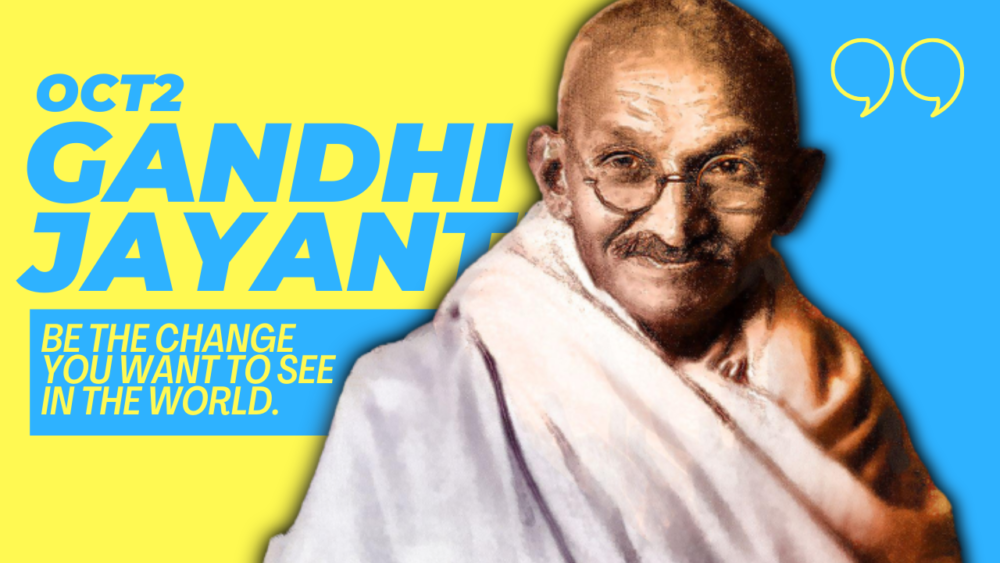

Gandhi Jayanti, observed every year on 2 October, marks the birth anniversary of Mohandas Karamchand Gandhi, born in Porbandar, Gujarat, in 1869. In 2026 India marked his 157th birth anniversary. His core teachings, truth, non-violence, self-reliance, simple living, cleanliness and service to the poorest, remain relevant to everyday life today.
Gandhi led India’s freedom movement through peaceful mass protest, and the title Mahatma, meaning great soul, stuck with him for life. What makes his ideas last is that they are practical. Below are his key teachings, with short lines he wrote or is reliably credited with, and how they apply now.
Gandhi Jayanti: quick facts
| Date | 2 October every year |
| Born | 2 October 1869, Porbandar, Gujarat |
| Died | 30 January 1948, New Delhi |
| Status | One of India’s three national holidays |
| Global observance | International Day of Non-Violence, declared by the UN in 2007 |
| 2026 anniversary | 157th birth anniversary |
Gandhi’s teachings that still hold true
1. Truth above everything
Gandhi called his autobiography The Story of My Experiments with Truth. Over time he moved from saying “God is Truth” to saying “Truth is God”, meaning that honesty was his highest value.
 Also read7 Indian Books That Should Be Made Into Films or Web Series
In daily life, this means being honest even when it costs something, whether in exams, at work or online. In a time of fake news and edited images, checking facts before sharing is a modern form of the same idea.


2. Non-violence is strength, not weakness
Ahimsa, or non-violence, was the base of Gandhi’s politics. Movements such as the Salt March of 1930 showed that peaceful protest could challenge a powerful empire.
Today, it is a reminder that disagreements, from family arguments to social media debates, can be handled without aggression or abuse.
3. Forgiveness takes courage
Gandhi wrote in Young India in 1931: “The weak can never forgive. Forgiveness is the attribute of the strong.”
Holding grudges hurts the person who holds them. Forgiving does not mean accepting wrong behaviour. It means choosing not to be ruled by anger.
4. Oppose the wrong, not the person
In his autobiography, Gandhi urged people to “hate the sin and not the sinner.” He fought British rule but did not preach hatred of the British people.
This idea helps at work and at home: criticise a decision or an action, not the dignity of the person behind it.
5. Need, not greed
Gandhi is credited with the thought that the earth provides enough for every person’s need, but not for every person’s greed. He lived simply, wore khadi he spun himself and owned very little.
The idea fits today’s concerns about climate change, waste and debt-driven spending. Buying less and reusing more are small, practical steps in the same direction.
6. Self-reliance through swadeshi
The spinning wheel, or charkha, became the symbol of Gandhi’s swadeshi movement, which urged Indians to make and buy local goods instead of imported cloth.
The spirit of supporting local artisans, small businesses and Indian products continues in many forms today, from handloom fairs to local brands.
7. Cleanliness as a duty
Gandhi placed great importance on sanitation and asked his followers, including himself, to clean toilets, a job many considered beneath them. He linked cleanliness with dignity and good health.
The Swachh Bharat Mission was launched on Gandhi Jayanti in 2014, and its second phase began on Gandhi Jayanti in 2021, which shows how closely the idea is tied to his legacy.
8. Gandhi’s talisman: think of the poorest
Shortly before his death, Gandhi gave a simple test for anyone in doubt. Recall the face of the poorest and weakest person you have seen, and ask whether your next step will help that person.
This talisman is printed in many Indian school textbooks and is still a useful guide for leaders, officials and ordinary citizens making choices that affect others.
9. Live what you preach
When asked for a message, Gandhi is reported to have replied, “My life is my message.” He tried to make his personal habits match his public principles.
The lesson is simple: people trust actions more than speeches.
A note on popular “Gandhi quotes”
Many lines shared on Gandhi Jayanti are not his exact words. The popular “Be the change you wish to see in the world” is a short paraphrase of a longer idea he wrote about, not a direct quote. Before sharing a quote, check it against collections of his writings such as those published by the Gandhi Heritage Portal or mkgandhi.org.
How Gandhi Jayanti is observed
- Prayer meetings and tributes at Raj Ghat in New Delhi, where he was cremated.
- Singing of his favourite bhajan, Raghupati Raghav Raja Ram, at many events.
- Cleanliness drives, essay competitions and school programmes.
- Banks, government offices and most schools stay closed.
Read more on Indian history and leaders in our people section and education section.
Frequently asked questions
Why is Gandhi Jayanti celebrated on 2 October?
It is Mahatma Gandhi’s birthday. He was born on 2 October 1869 in Porbandar, Gujarat.
Which birth anniversary of Gandhi was marked in 2026?
2 October 2026 marked his 157th birth anniversary.
Why is 2 October also the International Day of Non-Violence?
The United Nations General Assembly declared Gandhi’s birthday the International Day of Non-Violence in 2007, in honour of his philosophy.
What was Gandhi’s main teaching?
His central ideas were truth (satya) and non-violence (ahimsa), which guided both his personal life and his political work.
Sources: mkgandhi.org, United Nations: International Day of Non-Violence, Wikipedia: Gandhi Jayanti.