



Tvasta Manufacturing Solutions is a Chennai-based construction technology startup founded in 2016 by IIT Madras alumni. It uses large concrete 3D printers to build structures layer by layer. In April 2021 it delivered India’s first 3D printed house on the IIT Madras campus, a 600 sq ft single-storey home.
When the startup first made news in 2020, its founders said a house could be built in a few weeks at a much lower cost than a conventional one. This explainer looks at what Tvasta actually built, how the technology works, what has changed since, and what is still a claim rather than proven fact.
Tvasta at a glance
| Detail | Information |
|---|---|
| Company | Tvasta Manufacturing Solutions |
| Founded | 2016 |
| Founders | Adithya VS, Vidyashankar C and Parivarthan Reddy, all IIT Madras alumni |
| Base | Chennai, incubated at IIT Madras |
| Best-known project | India’s first 3D printed house, IIT Madras, inaugurated 27 April 2021 |
| Recent development | Minority equity investment from EKI Energy Services, announced in 2025 |
Who started Tvasta
Tvasta was set up by three mechanical engineering graduates of IIT Madras: Adithya VS, who serves as CEO, Vidyashankar C and Parivarthan Reddy. The company grew out of the institute’s startup ecosystem and was incubated there.
 Also readInternational Mother Language Day: History, 2026 Theme and Facts
The founders’ pitch was simple. Construction in India is slow, labour-heavy and wasteful, and housing demand far exceeds supply. Printing walls directly from a digital design, they argued, could cut time, material waste and dependence on manual labour.
India’s first 3D printed house
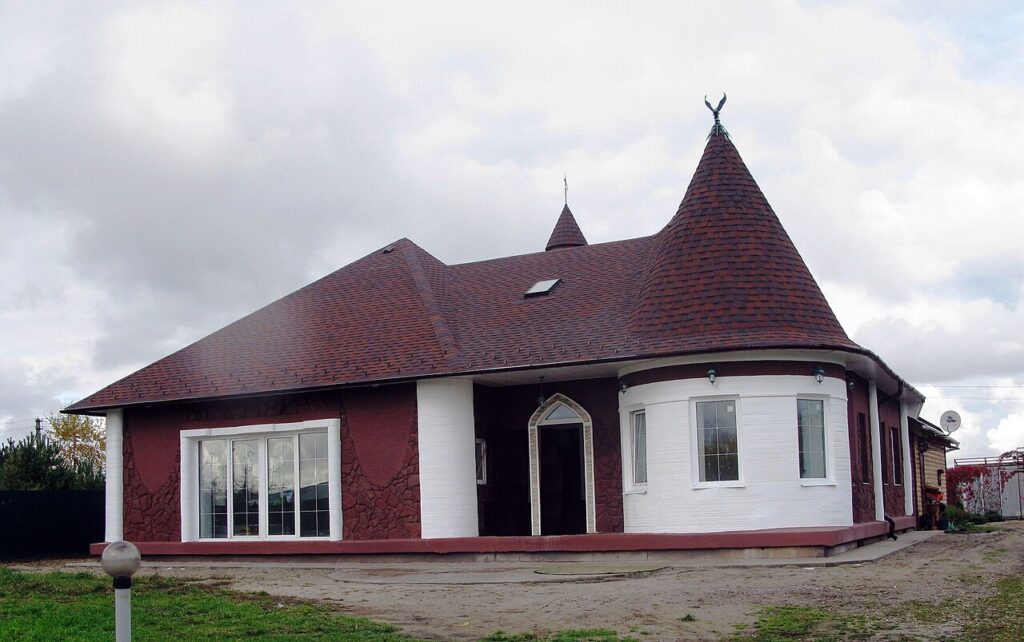
On 27 April 2021, Union Finance Minister Nirmala Sitharaman inaugurated the 600 sq ft house built by Tvasta at IIT Madras. According to the institute’s press release, the project was done with Habitat for Humanity’s Terwilliger Center for Innovation in Shelter, and the technology can print such a house in about five days.
The house used Tvasta’s own concrete 3D printing system and was described by IIT Madras as an indigenous technology. The project was linked to the government’s push for affordable housing, and the startup was part of an incubator at IIT Madras supported by the Ministry of Housing and Urban Affairs.
How concrete 3D printing works
A construction 3D printer works like a very large version of a desktop printer. Instead of plastic, it pushes out a special concrete mix through a nozzle, following a path set by computer software.
- Design: An architectural plan is converted into a digital model and then into printing paths.
- Material: A fast-setting concrete mix is prepared. Tvasta says it uses its own mix designed for printing.
- Printing: The printer lays the walls layer by layer, often with hollow sections for insulation, wiring and plumbing.
- Finishing: Roofs, doors, windows, electricals and plumbing are added, largely in the conventional way.
The main advantages claimed for this method are speed, less material waste and fewer workers on site. Designs with curved walls, which are costly by hand, are also easier to print.
What the 2020 claims said, and how to read them
In early media coverage, the founders said a house could be finished in under three weeks at nearly half the cost of traditional construction. They also said the company had approval to build up to ground plus two floors.
These were company statements. Independent, published data comparing the full lifetime cost of Tvasta’s homes with conventional homes is limited. Cost savings also depend on scale, site conditions, local labour costs and how much of the building, such as the roof and foundation, is still built conventionally. Readers should treat headline numbers as estimates.
What has happened since
3D printed construction in India has moved beyond a single demonstration house. In August 2023, India’s first 3D printed post office opened in Bengaluru’s Cambridge Layout. That building was constructed by Larsen and Toubro, with technical validation from IIT Madras, showing that larger firms have also entered the field.
For Tvasta, a notable recent development came in 2025, when listed carbon credit firm EKI Energy Services announced it would take a minority equity stake in the company. Trade outlet Machinist reported that EKI planned to work with Tvasta on its 3D printing operations as part of a move to diversify.
For more on Indian startups and new technology, see our technology section.
Why it matters for Indian housing
India’s housing shortage runs into millions of units, especially for lower-income urban families. Any method that cuts time and cost could help, which is why government bodies and institutes such as IIT Madras have backed early projects.
At the same time, 3D printing is still a small part of Indian construction. Wider use will depend on building codes, trained operators, the cost of printers and materials, and proof that printed buildings perform well over decades. Our finance coverage tracks how such technology affects housing costs for buyers.
Further reading: Habitat for Humanity, the USA..
Frequently asked questions
What is Tvasta?
Tvasta Manufacturing Solutions is a Chennai-based startup founded in 2016 by IIT Madras alumni. It builds structures using concrete 3D printing.
Did Tvasta build India’s first 3D printed house?
Yes. Its 600 sq ft house at IIT Madras was inaugurated by Finance Minister Nirmala Sitharaman on 27 April 2021, according to IIT Madras.
Is a 3D printed house really half the cost?
The founders made that claim in 2020. Actual savings vary by project and have not been independently verified at scale, so treat the figure as an estimate.
Who built India’s first 3D printed post office?
The Bengaluru post office opened in 2023 was built by Larsen and Toubro, with technical support from IIT Madras.
Sources: IIT Madras press release, Machinist: EKI invests in Tvasta, Inc42: Tvasta company profile.