[ad_1]
Tango without gender-defined roles. Women who dance with women. Men who are led by women. The queer milonga was introduced in Argentina at the beginning of the 2000s to break with the stereotypes set by the traditional, heteronormative tango.
Welcome to La Furiosa Milonga, in the City of Buenos Aires. Two women glide on the dance floor, tracing graceful figures with their feet. They wear red and black skirts and patent-leather shoes. They smile. A few yards from them, two other women wearing urban sneakers and baggy shirts dance with the same elegance. From a side entrance, two men walk onto the dance floor; first the look, then the embrace that initiates the movement. In this milonga (ballroom), there are no assigned roles or patterns to follow. Cabeceo (nodding) or guidance are not exclusively for men.
 Also readTunisia’s new parliament convenes for first time since dissolution in 2021
“Queer tango is a space for embraces, tango and activism, all at the same time,” says Liliana Furió, the documentary film director who founded La Furiosa Milonga in 2018. It is a concept that has been adopted by several of the other milongas that have proliferated in the Argentinian capital since the early 2000s. “It’s a one-way trip,” Furió explains. “The idea is that there are no assigned roles according to gender, anyone can decide to lead or to be led. The most interesting part is that everyone can enjoy playing both roles. That’s the most beautiful thing about the embrace of queer tango: When you play both roles, it enriches your dance. Then you don’t want to stay in one role anymore. When you have the power, the power to feel the freedom of switching roles, it’s amazing.”
Queer tango takes a relaxed approach to the looks, the nodding and the clothing. It doesn’t matter who takes the initiative, who nods asking to dance or who leads the dance. “If you want, you can dance barefoot,” says Furió, who began tango lessons in 2003 with writer Mariana Docampo, a pioneer of queer tango in Argentina. “Tango activism is very important. From the beginning, I understood it that way, it seemed to me like a tool, a very powerful body language to fight against the struggles we were facing. Before I took lessons, the dance seemed divine to me but full of an intolerable sexism. I quickly understood the utility and the importance of this language.” Furió is also an activist for Human Rights and co-founder of Historias Desobedientes, an association for daughters and sons of those responsible for the genocides of the last Argentinian military-civic dictatorship. Her father, Paulino Furió, was sentenced to life imprisonment for the disappearance of at least 20 people.
In 2001, when Argentina was going through a severe economic, political and social crisis, Docampo started her tango lessons for women. First she taught friends, then larger groups in rehearsal rooms before teaching classes at La Casa del Encuentro. “It was a feminist lesbian place. It was supposed to be queer, but I gave classes only to women because that’s what the place allowed. Then in 2005, we opened Tango Queer in Simón En Su Laberinto, in the San Telmo neighborhood.” It was a disruptive concept in a hugely sexist world.
Augusto Balizano also contributed to this experience with La Marshall, the first gay milonga in Buenos Aires. From that moment on, they co-created and have been directing the Buenos Aires International Queer Tango Festival. “In 2001, the Civil Union Law was passed, ushering in LGBT rights, which helped the growth of queer tango,” says Docampo. “Starting with the milonga, we began spreading the approach and concept during a time of great openness at the political level.”
In 2022, the 14th edition of the festival was held in the City of Buenos Aires. “The first edition was the biggest, the most disruptive. It represented change in the tango but in other areas as well; it was possible because something different was happening on a broader level. It was time to set a mark. Then we just had to maintain the space and legitimize it,” says Docampo. “In the last edition, we wanted to make all the milongas and the diverse tango practices visible and to showcase all the people who were partaking. To establish ourselves as a place of legitimacy, of support. The idea is not only to attract the public but to continue strengthening that space, a space where we can express our feelings and embrace new concepts.”
In 2015, after the irruption of Ni Una Menos, with women and dissidents protesting in the streets, feminist tango took root in Argentina. New milongas emerged and new orchestras were formed, consisting of women, lesbians, trans and non-binary identities. One of these is La Empoderada Orquesta Atípica. In 2018, the Tango Feminist Movement (MFT) was created, a group of women that was born with the fourth feminist wave and focused on preventing violence. One of the first actions taken was the adoption of a protocol against sexist violence, a guide to dealing with violence, harassment or discomfort in dance halls.
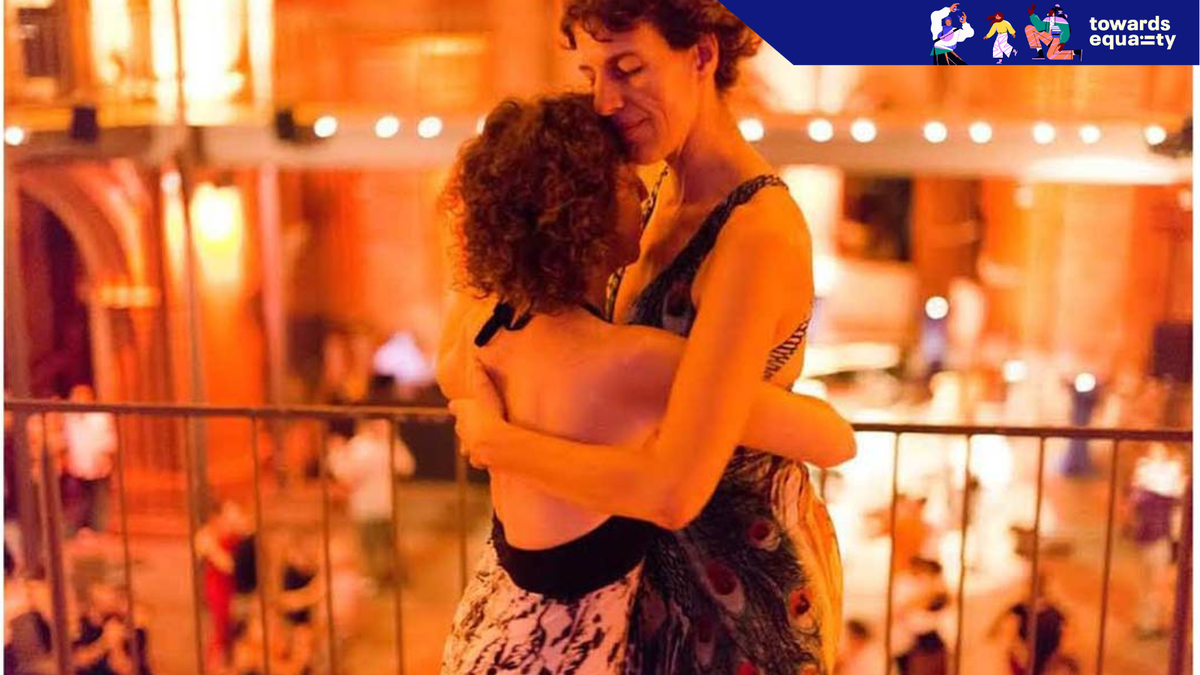
At the beginning, the proposal was disturbing in a largely macho world and gradually consolidated itself as a space of queer legitimisation.
Anahí Pérez Pavez, journalist and author of the book Tango y feminismo, considers that this is a new phase of the same movement that was the impetus for queer tango. “Now there is a confluence between cis-hetero women and all the diversity of lesbians, who are pioneers in this story and paved the way. Queer tango used to be marginalized, then the State began to appropriate it and make it gay-friendly. Many of the women who practiced it began questioning the contradiction of perceiving oneself as a woman, a person and a subject in a space that limits what a woman can do. You couldn’t ask a man out to dance because that seemed bad. Or suddenly, you were experiencing harassment or abuse, also micromachismo,” she says.
Feminist tango now finds its expression in the public space; in the streets asking for legal, safe and free abortion; or at women’s meetings. “We as activists meet up with dancers, with female musicians and producers. The intergenerational barriers have broken down. We have converged. We have a feminist political declaration—taking the milonga to the streets and taking the streets to the milonga. We take the lead and learn from those who started it,” says Pavez, who is also a member of MFT.
Furió looks back at two decades of queer tango and points out the link between activism and tango: “The body language and struggles deriving from art and dance are important; they come from a place of collectivism and community. That is the fundamental premise and challenge: to understand that individuality does not exist, it is useless. We are nothing and no one without one another.” Bodies torn between enjoyment and conflict. Body language as a political tool. Tango as a space for activism.
Read all stories from the Towards Equality campaign here.
[ad_2]