



The most ancient forts and palaces in India include Gwalior Fort, whose origins go back to at least the 6th century, Chittorgarh Fort, Golconda Fort and Jaisalmer Fort. Alongside them stand later royal landmarks such as Mehrangarh, Amber, Agra Fort and the Red Fort. This list arranges 10 of them roughly by age, with the history behind each one.
Several of these sites are protected as UNESCO World Heritage Sites, and most are maintained by the Archaeological Survey of India or by royal trusts. They are also among the most visited places on any heritage trip across north and central India. For more ideas, see our travel section.
Quick facts: 10 ancient forts and palaces of India
| Fort or palace | Location | Earliest known period | UNESCO status |
|---|---|---|---|
| Gwalior Fort | Madhya Pradesh | 6th century or earlier | No |
| Chittorgarh Fort | Rajasthan | Around 5th to 7th century | Yes (2013) |
| Golconda Fort | Hyderabad, Telangana | Kakatiya era, 11th to 13th century | No |
| Jaisalmer Fort | Rajasthan | 1156 | Yes (2013) |
| Mehrangarh Fort | Jodhpur, Rajasthan | 1459 | No |
| City Palace | Udaipur, Rajasthan | 1559 | No |
| Agra Fort | Uttar Pradesh | Rebuilt by Akbar from 1565 | Yes (1983) |
| Junagarh Fort | Bikaner, Rajasthan | 1589 to 1594 | No |
| Amber Fort | Jaipur, Rajasthan | 1590s | Yes (2013) |
| Red Fort | Delhi | 1639 to 1648 | Yes (2007) |
The 10 most ancient forts and palaces in India
1. Gwalior Fort, Madhya Pradesh
Gwalior Fort sits on a sandstone hill above the city and is one of the oldest forts in the country. Historians date its earliest structures to the 6th century or earlier, and it is clearly recorded by the 8th century. Over the centuries it passed through the hands of several dynasties, from the Pratiharas and Tomars to the Mughals and the Scindias.
 Also read8 Fascinating Museums In Egypt To Visit In 2026: A Full Guide
Inside are the Teli Ka Mandir, a tall temple linked to the Pratihara period, and the Man Mandir Palace built by Raja Man Singh Tomar in the 15th century, known for its blue tile work. A small temple on the hill, the Chaturbhuj temple, carries one of the oldest known inscriptions showing zero as a written number.
2. Chittorgarh Fort, Rajasthan
Chittorgarh Fort, once called Chitrakut, is among the largest forts in India and covers roughly 280 hectares on a hilltop. Its earliest fortifications are dated to around the 5th to 7th century, and it later became the seat of the Mewar rulers. The fort faced three major sieges, in 1303, 1535 and 1568.
Visitors come for the nine-storey Vijay Stambh, built by Rana Kumbha between 1458 and 1468, the older Kirti Stambh, and the palace ruins linked to the legend of Rani Padmini. It is part of the Hill Forts of Rajasthan group listed by UNESCO in 2013.
3. Golconda Fort, Hyderabad
Golconda began as a mud fort under the Kakatiya rulers and was later rebuilt in granite by the Qutb Shahi sultans after 1518. It became a major centre of the diamond trade, and famous stones such as the Koh-i-Noor are associated with the Golconda mines. The fort fell to the Mughal emperor Aurangzeb in 1687 after an eight-month siege.
Its best-known feature is the acoustic design at the Fateh Darwaza entrance. A clap under the dome can be heard at the Bala Hisar pavilion at the top, nearly a kilometre away, which once served as an early warning system.
4. Jaisalmer Fort, Rajasthan
Founded in 1156 by Rawal Jaisal, Jaisalmer Fort is built from yellow sandstone that turns golden in the afternoon light, which is why it is called Sonar Quila. It stands on Trikuta Hill in the Thar Desert.
It is one of the few forts in the world where people still live. Narrow lanes inside hold homes, shops, Jain temples and havelis. It is also part of the UNESCO-listed Hill Forts of Rajasthan.
5. Mehrangarh Fort, Jodhpur
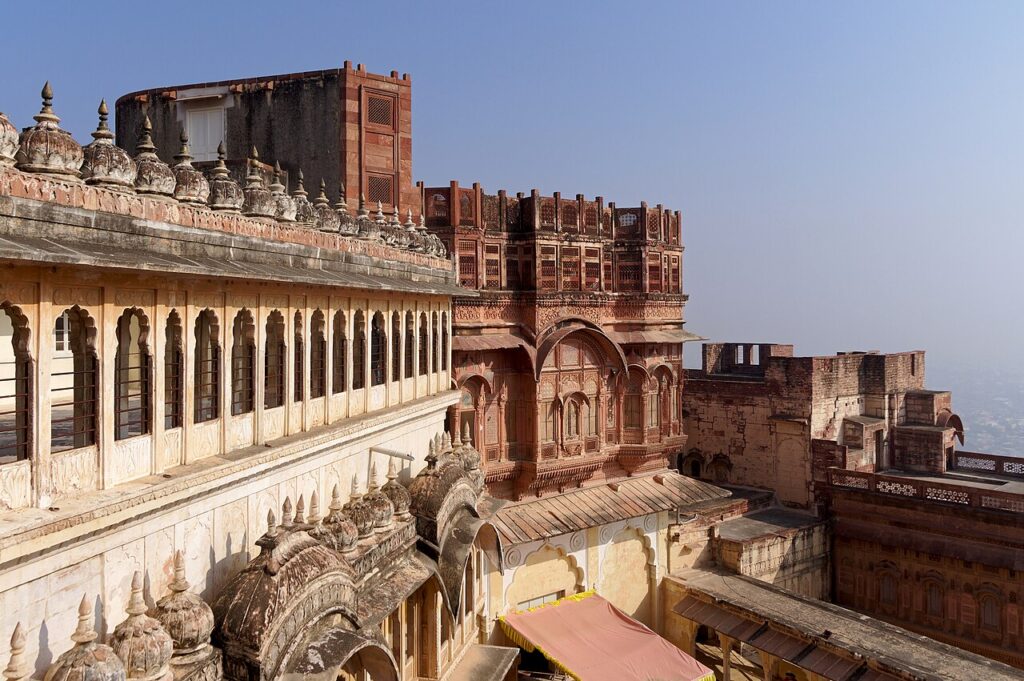
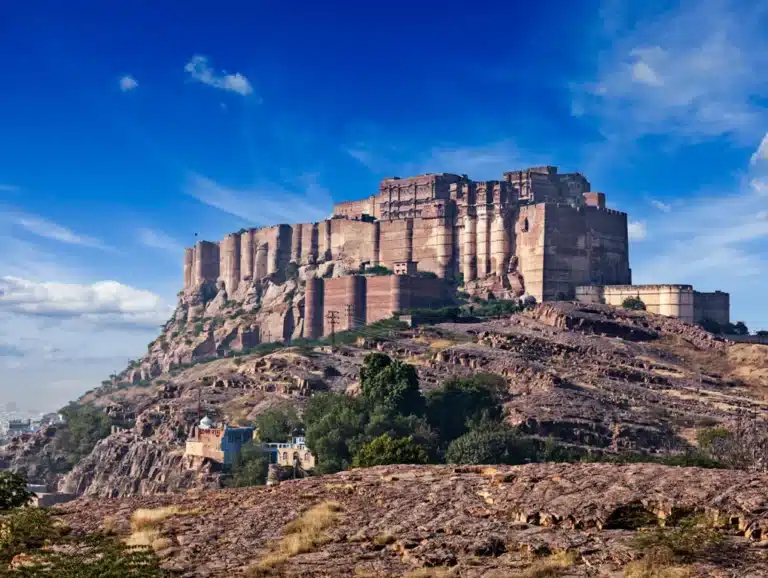
Rao Jodha, the Rathore ruler, laid the foundation of Mehrangarh in 1459 on a rocky hill about 125 metres above Jodhpur. Its thick walls still show marks from cannonball attacks.
Inside are palaces such as Moti Mahal and Phool Mahal, a well-kept museum of arms, paintings and palanquins, and wide views over the blue houses of the old city. The fort is run by the Mehrangarh Museum Trust.
6. City Palace, Udaipur
Maharana Udai Singh II began the City Palace in 1559 on the banks of Lake Pichola, and later rulers kept adding to it for nearly 400 years. The result is a long complex of courtyards, balconies, towers and domes in a mix of Rajasthani and Mughal styles.
Part of the palace is now a museum on the Mewar dynasty, with galleries of glass and mirror work, paintings and royal objects. Boat rides on Lake Pichola give one of the best views of the façade.
7. Agra Fort, Uttar Pradesh
An older fort stood here before the Mughals, but Emperor Akbar rebuilt it in red sandstone from 1565. Shah Jahan later added white marble buildings such as the Diwan-i-Khas and Musamman Burj. Shah Jahan spent his last years here under house arrest, with a view of the Taj Mahal across the Yamuna.
UNESCO listed Agra Fort as a World Heritage Site in 1983. It is about 2.5 km from the Taj Mahal, so most visitors see both on the same day.
8. Junagarh Fort, Bikaner
Junagarh Fort was built between 1589 and 1594 under Raja Rai Singh, the sixth ruler of Bikaner, with his minister Karan Chand overseeing the work. Unlike most Rajasthan forts, it stands on flat land rather than a hill.
Its palaces, including Karan Mahal, Anup Mahal, Phool Mahal and Badal Mahal, are known for painted ceilings, mirror work and carved balconies. A museum inside displays weapons, costumes and a First World War era biplane.
9. Amber Fort, Jaipur
Raja Man Singh I began Amber Fort in the 1590s on a hill above Maota Lake, about 11 km from Jaipur. It was the seat of the Kachwaha rulers before they moved to Jaipur city in the 18th century.
The fort blends Rajput and Mughal styles. Its highlight is the Sheesh Mahal, a hall covered in small mirror pieces. Amber is one of the six forts in the UNESCO-listed Hill Forts of Rajasthan and hosts an evening light and sound show.
10. Red Fort, Delhi
The youngest on this list, the Red Fort was built by Shah Jahan between 1639 and 1648 when he moved the Mughal capital to Shahjahanabad. Its red sandstone walls stretch for more than 2 km.
The Prime Minister hoists the national flag at the Red Fort every Independence Day. UNESCO listed the Red Fort Complex as a World Heritage Site in 2007. Read more about Indian history and culture in our infotainment section.
Tips for visiting ancient forts in India
- October to March is the most comfortable season for Rajasthan, Delhi, Agra and Madhya Pradesh.
- Check entry fees and timings on the ASI website or the fort’s official site before you go, as they are revised from time to time.
- Many ASI monuments now sell tickets online, and some offer a lower price for online payment.
- Wear comfortable shoes, as most hill forts involve steep ramps and uneven stone floors.
Further reading: Lake Pichola, Junagarh Fort, Jaisalmer Fort.
Frequently asked questions
Which is the oldest fort in India?
There is no single agreed answer, but Gwalior Fort and Chittorgarh Fort are among the oldest still standing, with structures dated to roughly the 5th to 8th century. Kangra Fort in Himachal Pradesh also claims very old origins.
Which Indian forts are UNESCO World Heritage Sites?
From this list, the Red Fort, Agra Fort, Chittorgarh, Jaisalmer and Amber are UNESCO sites. The last three are part of the Hill Forts of Rajasthan, listed in 2013 with Kumbhalgarh, Ranthambore and Gagron.
Is Jaisalmer Fort still inhabited?
Yes. Several thousand people live inside Jaisalmer Fort, which makes it one of the few living forts in the world.
What is the best time to visit forts in Rajasthan?
October to March is best, when days are cool and dry. Summer afternoons can be very hot in the desert districts.
Sources: UNESCO: Red Fort Complex, UNESCO: Agra Fort, UNESCO: Hill Forts of Rajasthan, Archaeological Survey of India.