
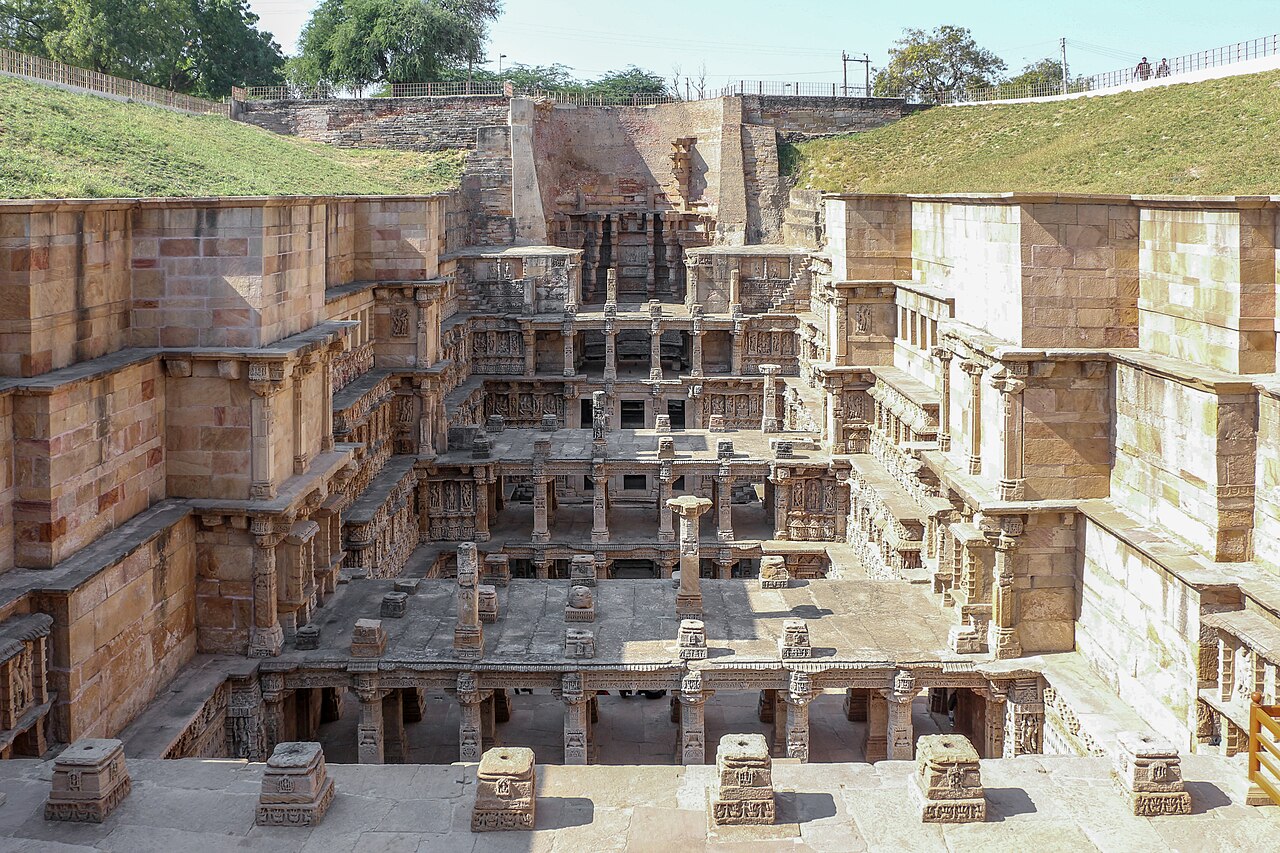

Stepwells of India are deep, stone-lined wells with long flights of steps that lead down to groundwater. Built mainly between the 7th and 19th centuries in western India, they stored water through dry months and served as cool resting places. The best known are Rani ki Vav in Gujarat, Chand Baori in Rajasthan and Agrasen ki Baoli in Delhi.
This guide explains how stepwells worked, why so many fell out of use, and which ones are worth a visit. It also lists the key facts for each site so you can plan a trip without guesswork.
What is a stepwell
A stepwell is a well, cistern or pond reached by a corridor of steps. Builders dug a deep trench, lined it with stone blocks and cut stairs down to the water table. As the water level rose in the monsoon and fell in summer, people could still reach it by walking down a few more steps.
 Also readIndian Classical Dance Forms: A Beginner’s Guide to All Eight
Many stepwells were plain and practical. Others were richly carved, with pillared pavilions, shrines and sculpted walls, because they were also places of rest, prayer and social meeting. The air at the lower levels stayed noticeably cooler than at the surface, which made them popular in the hot months.
Regional names
- Baoli, baori, bawdi: common in Hindi-speaking regions such as Rajasthan and Delhi.
- Vav or vaav: used in Gujarat and parts of Marwar.
- Kalyani or pushkarani: stepped tanks in Karnataka and the south.
- Barav: the Marathi term used in Maharashtra.
A short history
The idea of steps leading to water is very old in the subcontinent. Harappan sites such as Dholavira have stepped water tanks, and the Great Bath at Mohenjo-daro has steps on two sides. Rock-cut stepwells began to appear around 200 to 400 CE, and the form spread across Gujarat and Rajasthan over the following centuries.
Royal women commissioned several of the finest stepwells, often as acts of charity or in memory of a husband. Later, the Mughals also supported their construction. During British rule, however, officials viewed stepwells as unhygienic and replaced many with pipes and pumps. Neglect, silt and falling groundwater levels did the rest, and many sites turned into dumping grounds before restoration work began in recent decades.
You can read more about India’s built heritage in our infotainment section.
7 famous stepwells of India
1. Rani ki Vav, Patan, Gujarat
Rani ki Vav, or the Queen’s Stepwell, was commissioned by Queen Udayamati of the Chaulukya dynasty in memory of King Bhima I. A medieval text dates its start to 1063 CE. It is about 65 metres long, 20 metres wide and 28 metres deep, with more than 500 principal sculptures and over 1,000 smaller ones, many showing the avatars of Vishnu.
Floods from the Saraswati river buried the stepwell in silt for centuries, which helped preserve its carvings. The Archaeological Survey of India (ASI) restored it in the 1980s, and UNESCO added it to the World Heritage List on 22 June 2014. Since 2018, it has appeared on the reverse of the Rs 100 note.
2. Chand Baori, Abhaneri, Rajasthan
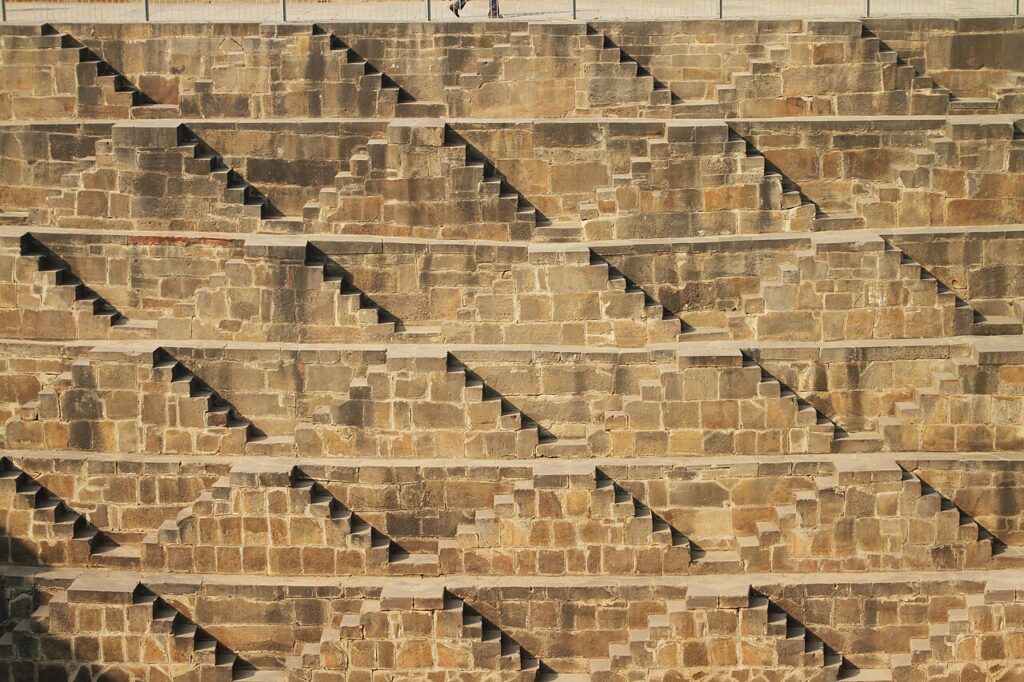
Chand Baori in Abhaneri village, Dausa district, is often called one of the deepest stepwells in India. It has about 3,500 narrow steps arranged in a criss-cross pattern across 13 storeys, going down roughly 30 metres. Historians date it to around the 9th century on stylistic grounds, and local tradition credits a ruler named Raja Chanda.
The Harshat Mata temple stands next to it. The stepwell has appeared in Hindi films including Paheli and Bhool Bhulaiyaa. Abhaneri is a common stop on the road between Jaipur and Agra.
3. Adalaj ni Vav, near Ahmedabad, Gujarat
Adalaj stepwell lies about 18 km north of Ahmedabad. An inscription on site says Queen Rudabai, widow of the Vaghela ruler Virsinh, commissioned it, and dates it to 1498 CE. It is five storeys deep and known for its octagonal well shaft and detailed carvings of flowers, birds and everyday scenes.
It combines Hindu, Jain and Islamic design elements, which reflects the period in which it was built. Because it is close to the city, it is one of the easiest stepwells to visit.
4. Agrasen ki Baoli, New Delhi
Agrasen ki Baoli sits on Hailey Road, a short walk from Connaught Place. It is about 60 metres long and 15 metres wide, with 108 steps. There is no firm record of who built it, though tradition links it to the Aggarwal community. Its present form suggests a rebuild during the Tughlaq or Lodi period.
The ASI protects it as a monument of national importance. It has appeared in films such as PK and Sultan, which has made it a popular photo spot.
5. Rajon ki Baoli, Mehrauli, Delhi
Inside Mehrauli Archaeological Park, Rajon ki Baoli was built in 1506 CE by Daulat Khan Lodi, an official of the Lodi dynasty. The name refers to the masons, or raj mistris, who later lived nearby. It is a good add-on if you are already visiting the Qutub Minar area.
6. Raniji ki Baori, Bundi, Rajasthan
Bundi has dozens of stepwells, and Raniji ki Baori is the most famous. Rani Nathavati, queen of Raja Anirudh Singh, built it in 1699. It is about 46 metres deep, with carved gateways and pillars. Bundi itself is a quieter alternative to larger Rajasthan cities.
7. Toorji ka Jhalra, Jodhpur, Rajasthan
This stepwell near Jodhpur’s old city is traditionally said to have been built around 1740 by a queen of Maharaja Abhai Singh, though historians note there is no inscription to confirm this. After years of neglect, it was cleaned and restored and now sits at the centre of a busy neighbourhood of cafes and shops.
Quick facts table
| Stepwell | Location | Built | Key fact |
|---|---|---|---|
| Rani ki Vav | Patan, Gujarat | 11th century | UNESCO site since 2014 |
| Chand Baori | Abhaneri, Rajasthan | c. 9th century | About 3,500 steps, 13 storeys |
| Adalaj ni Vav | Near Ahmedabad | 1498 | Five storeys deep |
| Agrasen ki Baoli | New Delhi | Rebuilt 14th century | 108 steps |
| Rajon ki Baoli | Mehrauli, Delhi | 1506 | Built by Daulat Khan Lodi |
| Raniji ki Baori | Bundi, Rajasthan | 1699 | About 46 metres deep |
| Toorji ka Jhalra | Jodhpur, Rajasthan | c. 1740 | Restored and open to public |
Tips for visiting stepwells
- Go early: mornings have softer light for photos and fewer crowds, and the steps are not yet hot.
- Wear good footwear: steps are uneven and can be slippery after rain.
- Check entry rules: sites under the ASI have fixed hours and ticket rules, and some lower levels are closed to visitors.
- Respect the site: do not climb on carvings or leave litter. Many stepwells are still recovering from years of dumping.
- Plan a circuit: Rani ki Vav and Adalaj fit into one Gujarat trip, while Chand Baori pairs well with Jaipur.
For more trip ideas, see our travel guides.
Why stepwells matter today
Stepwells are now studied as examples of local water management. They collected rain and groundwater close to where people lived, and they are often cited in discussions on water conservation in dry regions. In several towns, old stepwells have been cleaned of debris and opened to visitors again.
They are also living public spaces. When restored well, a stepwell becomes a place for heritage walks, small concerts and school visits, which helps keep it in use and cared for.
Frequently asked questions
Which is the most famous stepwell in India?
Rani ki Vav in Patan, Gujarat, is the best known. It is a UNESCO World Heritage Site and appears on the Rs 100 note.
Which stepwell has the most steps?
Chand Baori in Abhaneri, Rajasthan, has about 3,500 steps across 13 storeys and is around 30 metres deep.
What is the difference between a baoli and a well?
An ordinary well is reached by rope and bucket. A baoli has steps leading down to the water, so people could reach it directly as the level changed.
Is there a stepwell in Delhi I can visit easily?
Yes. Agrasen ki Baoli near Connaught Place and Rajon ki Baoli in Mehrauli Archaeological Park are both open to visitors.
Sources: UNESCO: Rani-ki-Vav, Wikipedia: Stepwell, Wikipedia: Chand Baori, Archaeological Survey of India.