• About   |
  • Advertise |
  • Contact Us
No Result
View All Result
The Second Angle (TSA Magazine)
Advertise
  • Infotainment
    • Sports
    • People
    • Inspiring
  • Entertainment
    • Lifestyle
    • Home & Decoration
  • Buzz
  • Education
  • Travel
  • Finance
  • Healthcare
  • Technology
The Second Angle
No Result
View All Result
  • Infotainment
  • Entertainment
  • Buzz
  • Education
  • Travel
  • Finance
  • Healthcare
  • Technology
Advertisement Advertisement Advertisement
ADVERTISEMENT
Home World News

UAE, NASA missions find ‘patchy’ auroras in Mars atmosphere

by TSA Desk
September 1, 2022
in World News
Reading Time: 3 mins read
UAE, NASA missions find ‘patchy’ auroras in Mars atmosphere
Share on FacebookShare on WhatsApp
Advertisement Advertisement Advertisement
ADVERTISEMENT
3 min readGAdd The Second Angle as a preferred source on Google
Key takeaways
The new aurora found by the team is formed when the solar wind directly impacts Mars' upper atmosphere and emits ultraviolet light as it slows down.The new aurora found by the team is formed when the solar wind directly impacts Mars' upper atmosphere and emits ultraviolet light as it slows down.The United Arab Emirate's Mars Mission (EMM) and NASA's MAVEN probe have found "patchy" proton auroras in Mars' skies, providing new insights into the red planet's atmosphere.

[ad_1]

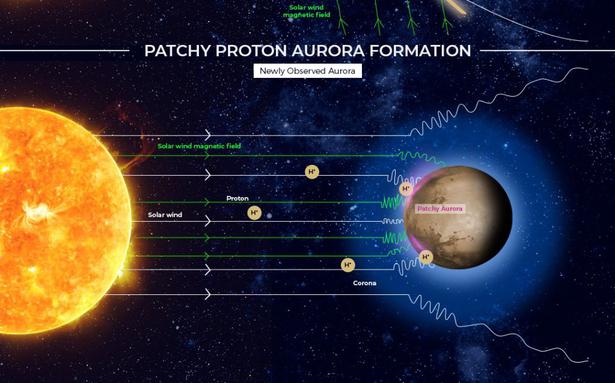
The new aurora found by the team is formed when the solar wind directly impacts Mars’ upper atmosphere and emits ultraviolet light as it slows down.

The new aurora found by the team is formed when the solar wind directly impacts Mars’ upper atmosphere and emits ultraviolet light as it slows down.

Liz Truss, Rishi Sunak make final pitches to Conservative voters in LondonAlso readLiz Truss, Rishi Sunak make final pitches to Conservative voters in London

The United Arab Emirate’s Mars Mission (EMM) and NASA’s MAVEN probe have found “patchy” proton auroras in Mars’ skies, providing new insights into the red planet’s atmosphere.

An aurora is a natural light display in a planet’s sky, predominantly seen in high-latitude regions such as the northern lights, or the aurora borealis, seen from the Earth.

The new aurora found by the team is formed when the solar wind directly impacts Mars’ upper atmosphere and emits ultraviolet light as it slows down.

It was discovered in snapshots of the dayside disk obtained by the Emirates Mars Ultraviolet Spectrometer (EMUS), which observes the planet’s upper atmosphere.

When the aurora occurs, small regions of the planet become much brighter, signifying intense localised energy in the atmosphere.

“Our discovery of these patchy proton aurora adds a new kind of event to the long list of those currently studied by EMM and challenges our existing views of how the proton aurora on Mars’ dayside are formed,” said Hessa Al Matroushi, EMM’s Science Lead.

“The EMM Hope probe has so far uncovered many unexpected phenomena that extend our understanding of Mars’ atmospheric and magnetospheric dynamics.”

“These new observations, combined with MAVEN data, have lifted the lid on entirely new possibilities for scientific research,” Ms. Matroushi said.

The new images represent the first time scientists had a global view of spatial variability in proton aurora at Mars, and the first time they been able to unambiguously observe this patchy structure, said EMM science team member Mike Chaffin, lead author of the study published in the journal Geophysical Research Letters.

“We know that these wavelengths are only emitted by the hydrogen atom, which tells us that super energetic hydrogen atoms must be present in the atmosphere in order to produce the auroral emission,” Mr. Chaffin said.

A data sharing agreement between EMM and MAVEN has enabled analysis of the new EMM images using plasma observations made by MAVEN, which has been characterising the Mars atmosphere since 2014.

In the new study, EMM discovered fine-scale structures in proton aurora that spanned the full day side of Mars.

Typical proton aurora observations made by MAVEN and ESA’s (the European Space Agency) Mars Express mission show these aurora appearing smooth and evenly distributed across the hemisphere.

By contrast, EMM observed proton aurora that appeared highly dynamic and variable, the researchers said.

These “patchy proton aurora” form when turbulent conditions around Mars allow the charged particles to flood directly into the atmosphere and glow as they slow down, they said.

UAE’s Hope mission has observed patchy aurora multiple times over the course of its mission so far, and the shape of the aurora is not always the same.

“Whether we will see anything as spectacular as what we’ve already got is anyone’s guess, but I am hopeful. Hope continues to far exceed our expectations for scientific discovery, and I can’t wait to see what we learn next,” Mr. Chaffin added.

[ad_2]

Source

Enjoyed this story?Share it with your friends
WhatsAppLinkedInXFacebookEmail
See more TSA Mag stories on GoogleAdd us as a preferred source and our stories will show up more often in your Top Stories.
GAdd The Second Angle as a preferred source on Google
ShareSend
Tweet
Previous Post

Malayalam film industry expects a blockbuster Onam this time

Next Post

The Alarming State Of Oral Health

Related Posts

LGBTQIA+ in Afghanistan
World News

LGBTQIA+ in Afghanistan: Life Under Taliban Rule in 2026

LGBTQIA+ in Afghanistan: the law before 2021, abuses reported under the Taliban, and the July 2025 ICC arrest warrants that...

Read moreDetails
chinese
Opinion

Boycott Chinese Products: What Changed in India Since 2020

Did the call to boycott Chinese products after Galwan work? A look at app bans, investment rules, phone sales and...

Read moreDetails
The United Kingdom, spending $800,000 to conceal Mountbatten's diaries
World News

Mountbatten Diaries Case: What the UK Tribunal Decided and Why

The Mountbatten diaries case explained: why historian Andrew Lownie went to court, what the 2022 UK tribunal ruled and what...

Read moreDetails
Top 10 Richest Men In The World: Billion Dollar Club Family
Listicles

Top 10 Richest Men in the World in 2026: Forbes List Explained

The top 10 richest men in the world in October 2026 per Forbes: Elon Musk leads at $936 billion, then...

Read moreDetails
Richest Kids in the world
Entertainment

Top 10 Richest Kids in the World and Where They Are Now (2026)

The top 10 richest kids in the world from the 2020 Kids Rich List, led by Morocco's Moulay Hassan, plus...

Read moreDetails
At least 25 killed in rebel attack on Ugandan school near Congo border
World News

At least 25 killed in rebel attack on Ugandan school near Congo border

The Allied Democratic Forces, or ADF, is accused of launching many attacks on civilians in recent years, notably on civilian...

Read moreDetails
Load More
Next Post
The Alarming State Of Oral Health

The Alarming State Of Oral Health

About

The Second Angle

The Second Angle (TSA Mag) is an infotainment and lifestyle magazine covering entertainment, travel, technology, health, education and finance.

Important Links

  • About The Second Angle
  • Advertise With Us
  • Editorial Policy
  • Privacy Policy
  • Terms and Conditions
  • Contact Us
  • Careers
  • Newsletter

Explore

  • Infotainment
  • Entertainment
  • Buzz
  • Education
  • Travel
  • Finance
  • Healthcare
  • Technology
Advertise with us

© 2017-2026. The Second Angle. All Rights Reserved. Developed and Managed by Squarebase.io

Welcome Back!

Login to your account below

Forgotten Password?

Retrieve your password

Please enter your username or email address to reset your password.

Log In
No Result
View All Result
  • Infotainment
    • Sports
    • People
    • Inspiring
  • Entertainment
    • Lifestyle
    • Home & Decoration
  • Buzz
  • Education
  • Travel
  • Finance
  • Healthcare
  • Technology

© 2017-2026. The Second Angle. All Rights Reserved. Developed and Managed by Squarebase.io

We use cookies to keep TSA fast and relevant. Read our Privacy Policy.