• About   |
  • Advertise |
  • Contact Us
No Result
View All Result
The Second Angle (TSA Magazine)
Advertise
  • Infotainment
    • Sports
    • People
    • Inspiring
  • Entertainment
    • Lifestyle
    • Home & Decoration
  • Buzz
  • Education
  • Travel
  • Finance
  • Healthcare
  • Technology
The Second Angle
No Result
View All Result
  • Infotainment
  • Entertainment
  • Buzz
  • Education
  • Travel
  • Finance
  • Healthcare
  • Technology
Advertisement Advertisement Advertisement
ADVERTISEMENT
Home Explainers

Why do farmers fight for APMC and MSP

At the Singhu border, agitation persists and farmers show no sign of backing down as fear over the future of APMC mandis solidifies.

by TSA Desk
December 21, 2021
in Explainers, Featured
Reading Time: 3 mins read
Photo Credit : ANI

Photo Credit : ANI

Share on FacebookShare on WhatsApp
Advertisement Advertisement Advertisement
ADVERTISEMENT
4 min readGAdd The Second Angle as a preferred source on Google
Key takeaways
After Indian independence, the agricultural distribution segment was run by money lenders and high-end traders, unable to access the markets, farmers back then were perpetually in debt.To combat the apparent problem, the government of India enacted Agricultural Produce Markets Regulation (APMR) Acts during the sixties and seventies.These mandis required traders to obtain a licence for procurement of produce and established a minimum support price (MSP) to provide farmers assurance against acute fall in prices.

After Indian independence, the agricultural distribution segment was run by money lenders and high-end traders, unable to access the markets, farmers back then were perpetually in debt.

To combat the apparent problem, the government of India enacted Agricultural Produce Markets Regulation (APMR) Acts during the sixties and seventies. Designated market areas were established in states under the jurisdiction of the Agricultural Produce Market Committee (APMC).

 

India: A new era of Gender Equality in ScienceAlso readIndia: A new era of Gender Equality in Science
APMC mandi
Photo credit : www.expresscomputer.in

These mandis required traders to obtain a licence for procurement of produce and established a minimum support price (MSP) to provide farmers assurance against acute fall in prices.

APMC Act directly contributed to the green revolution’s success as these incentives were uplifting for farmers and provided them with a fair shot at the practice.

Over the years, traders found loopholes in the regulated structure and several malpractices were observed. The market committee had little supervision and this led to the illegitimate sale of trade licences to the highest bidder. Demography of licensed traders changed to crooked intermediaries who formed cartels to extort farmers for cheaper prices.

Despite the imperfection of mandis, government support and guarantee provided under the APMC act was always an option for farmers to fall back on, until 2020.
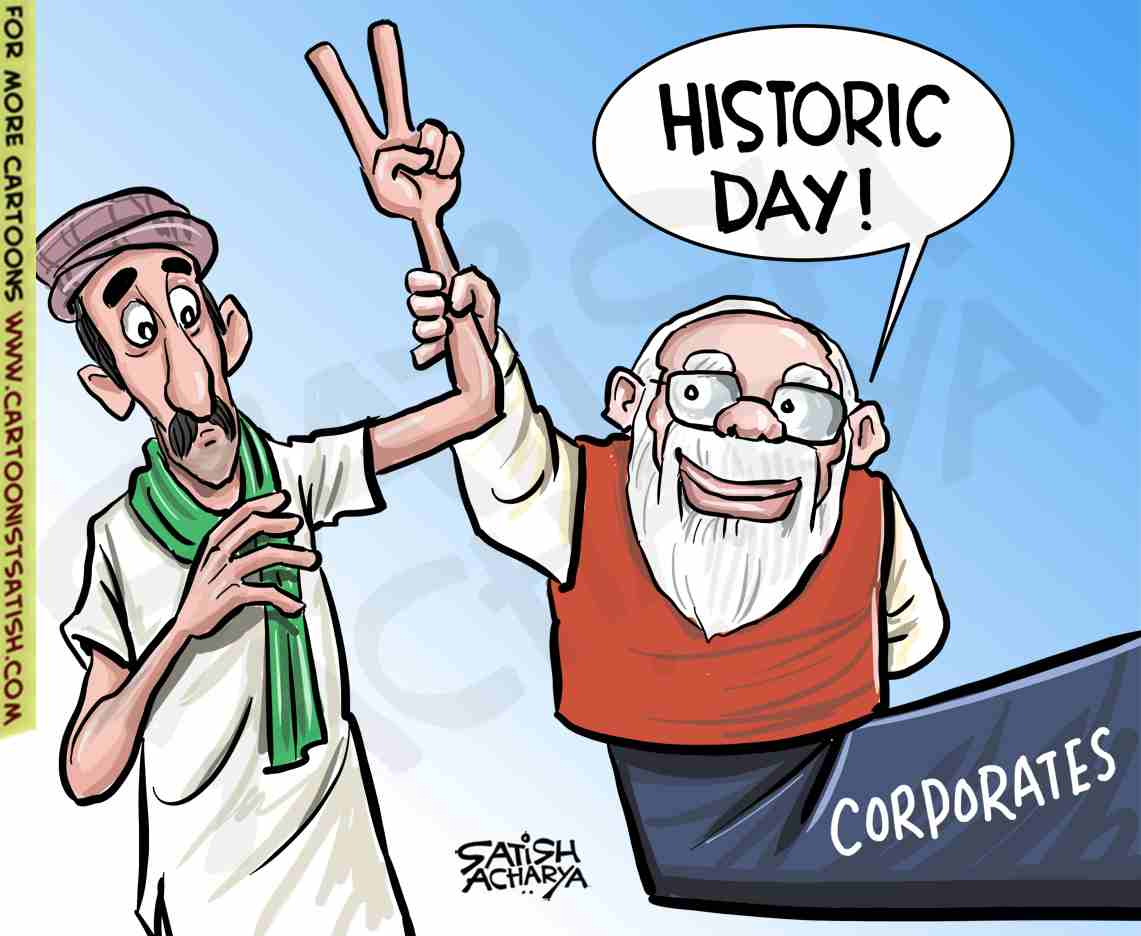
 

Why do farmers fight for APMC and MSP
Photo Credit : cartoonistsatish.com


Table of Contents
  • The 2020 ordinance  and the future of APMC 

The 2020 ordinance  and the future of APMC 

 One nation one market campaign heavily emphasises on the freedom, farmers will enjoy under the new Act. Modi government claims that the new legislation will allow farmers to sell anywhere they want, ignoring the fact that the farmers already had the freedom to sell anywhere under the previous legislation. Indian agriculture market is a two market entity, and this provides a reliable alternative to farmers.

Only 6 per cent of farmers get MSP; ie they sell in APMC regulated markets. 94 per cent of farmers chose to sell in the open market, this implies mandis don’t really have any restrictive hold on the agriculturists. 


Tax benefits

Traders will be exempt from market fees and taxes for trades outside of APMC mandis. Anyone will be able to buy directly from the farmer and not be required to pay any fees to the APMC. Absence of additional charges coupled with exclusive legislation will immediately open the gates for big conglomerates to flood in the agriculture sector of India.

Any person with a PAN card can acquire farm produce and shall be considered a trader, raising concerns for long term financial reliability.

This lucrative condition will make the unregulated market a very attractive option and eventually result in the collapse of mandis. 

Dispute resolution

Farmers cannot seek court interference in an event of a dispute with the unlicensed trader, they will have to approach their local SDMs and DMs.

Fears arise when uneducated farmers with finite resources get in legal battles with corporate powerhouses, recently, for growing the FC5 potato variety, exclusively grown Lay’s potato chips, Pepsi has sued the farmers in Gujarat. The variety of FC5 has a lower moisture content needed for snacks such as potato chips to be made. Pepsi-Co is demanding more than 10 million rupees daily for suspected patent infringement.

Why do farmers fight for APMC and MSP
Photo Credit: www.downtoearth.org.in

Essential Commodities Act

The Essential Commodities Act was established in 1955 to ensure the delivery of certain listed commodities if obstructed due to hoarding or black marketing, would severely affect the everyday life of people.

The new amendment deregulates commodities such as cereals, pulses, oil-seeds, edible oils, onion and potatoes. Without limits on food crop stockpile, hoarding and unusual price wars will become a casual reality impacting farmers and Indian households alike.

Farmers claim that the price triggers envisioned in the Bill are nonsensical and are so high that they will rarely ever be invoked.


There have been many efforts to facilitate dialogue, in vain as farmers say that the government has no intention of repealing the three ordinances and is attempting to delude with ambiguous declarations and deceitful tactics. At the Singhu border, agitation persists and farmers show no sign of backing down.

Also Read: Activists prepare “langar” for protesting farmers

 

Enjoyed this story?Share it with your friends
WhatsAppLinkedInXFacebookEmail
See more TSA Mag stories on GoogleAdd us as a preferred source and our stories will show up more often in your Top Stories.
GAdd The Second Angle as a preferred source on Google
ShareSend
Tweet
Previous Post

People Stood Strong With Protesting Farmers Aiding Them With Essentials Like Food, Medical Camps, Sanitary Products

Next Post

7 Exciting Places In India To Visit Post The COVID-19 Pandemic

Related Posts

Shoppers carrying bags past a store window with sale signs during the holiday shopping season
Explainers

When Is Black Friday 2026? Thanksgiving and Cyber Monday Dates

When is Black Friday 2026? It is on November 27, after Thanksgiving on November 26. See Cyber Monday, the 1941...

Read moreDetails
Analogue alarm clock on a bedside table showing early morning time in autumn
Explainers

When Does Daylight Saving Time End in 2026? Date and Time

When does daylight saving time end 2026? Clocks fall back at 2 a.m. on Sunday, 1 November. States that skip...

Read moreDetails
7 Beautiful Train Routes That You Must Travel
Explainers

Why Are Train Coaches Different Colours? ICF vs LHB Explained

Why are train coaches different colours in India? Blue ICF, red LHB, green Garib Rath and Vande Bharat liveries, safety...

Read moreDetails
PicsArt_11-02-09.24.24
Entertainment

Happy Birthday Shah Rukh Khan: A Heartfelt Letter as SRK Turns 61

Shah Rukh Khan birthday letter: as SRK turns 61 on 2 November 2026, a fan looks back at DDLJ, Jawan,...

Read moreDetails
Is AMU a Secular University? Minority Status Explained
Opinion

Is AMU a Secular University? Minority Status Explained

Is AMU a secular university? What the AMU Act says on admissions, the history of its minority status case and...

Read moreDetails
chinese
Opinion

Boycott Chinese Products: What Changed in India Since 2020

Did the call to boycott Chinese products after Galwan work? A look at app bans, investment rules, phone sales and...

Read moreDetails
Load More
Next Post
7 Exciting Places In India To Visit Post The COVID-19 Pandemic

7 Exciting Places In India To Visit Post The COVID-19 Pandemic

About

The Second Angle

The Second Angle (TSA Mag) is an infotainment and lifestyle magazine covering entertainment, travel, technology, health, education and finance.

Important Links

  • About The Second Angle
  • Advertise With Us
  • Editorial Policy
  • Privacy Policy
  • Terms and Conditions
  • Contact Us
  • Careers
  • Newsletter

Explore

  • Infotainment
  • Entertainment
  • Buzz
  • Education
  • Travel
  • Finance
  • Healthcare
  • Technology
Advertise with us

© 2017-2026. The Second Angle. All Rights Reserved. Developed and Managed by Squarebase.io

Welcome Back!

Login to your account below

Forgotten Password?

Retrieve your password

Please enter your username or email address to reset your password.

Log In
No Result
View All Result
  • Infotainment
    • Sports
    • People
    • Inspiring
  • Entertainment
    • Lifestyle
    • Home & Decoration
  • Buzz
  • Education
  • Travel
  • Finance
  • Healthcare
  • Technology

© 2017-2026. The Second Angle. All Rights Reserved. Developed and Managed by Squarebase.io

We use cookies to keep TSA fast and relevant. Read our Privacy Policy.