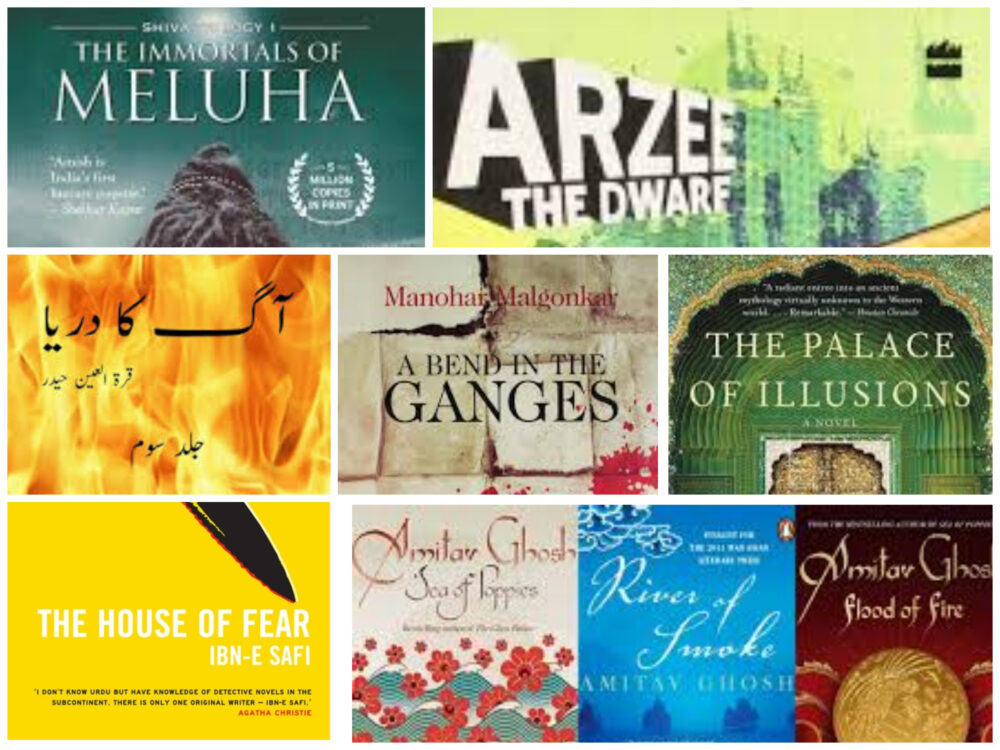

Seven Indian books that should be made into films are Aag Ka Darya, the Ibis trilogy, the Imran Series, A Bend in the Ganges, The Palace of Illusions, Arzee the Dwarf and The Immortals of Meluha. Each has a strong story and memorable characters, yet as of October 2026 none has reached the screen as a released film or series.
Indian cinema and streaming platforms adapt books more often now, from crime novels to historical sagas. Still, many important works in English, Urdu and other Indian languages remain untouched. Here is why these seven deserve a screen version, along with the latest known status of each.
- Quick look at the books
- 1. Aag Ka Darya by Qurratulain Hyder
- 2. The Ibis trilogy by Amitav Ghosh
- 3. The Imran Series by Ibn-e-Safi
- 4. A Bend in the Ganges by Manohar Malgonkar
- 5. The Palace of Illusions by Chitra Banerjee Divakaruni
- 6. Arzee the Dwarf by Chandrahas Choudhury
- 7. The Immortals of Meluha by Amish Tripathi
- What makes a book ready for the screen
- Frequently asked questions
Quick look at the books
| Book | Author | First published | Screen status |
|---|---|---|---|
| Aag Ka Darya | Qurratulain Hyder | 1959 | No adaptation |
| Ibis trilogy | Amitav Ghosh | 2008 to 2015 | TV series announced in 2019, not released |
| Imran Series | Ibn-e-Safi | From 1955 | No major adaptation |
| A Bend in the Ganges | Manohar Malgonkar | 1964 | No adaptation |
| The Palace of Illusions | Chitra Banerjee Divakaruni | 2008 | No adaptation |
| Arzee the Dwarf | Chandrahas Choudhury | 2009 | No adaptation |
| The Immortals of Meluha | Amish Tripathi | 2010 | Web series announced in 2022, not released |
1. Aag Ka Darya by Qurratulain Hyder
Published in Urdu in 1959, Aag Ka Darya covers more than 2,000 years of history, from the time of Chandragupta Maurya to India and Pakistan after Independence. Hyder translated it into English herself as River of Fire in 1998.
 Also readEssential Reading List to Understand Feminism: 18 Key Books
The novel follows characters who reappear across different eras, which shows how much people of the subcontinent share despite changing rulers and borders. A long-form series would suit its scale better than a single film.
2. The Ibis trilogy by Amitav Ghosh
The trilogy includes Sea of Poppies (2008), River of Smoke (2011) and Flood of Fire (2015). It is set in the 1830s, as tension builds towards the First Opium War, and moves between Calcutta, the ship Ibis, Mauritius and Canton in China.
The books deal with the opium trade and the transport of indentured labourers, told through a large cast from many backgrounds. A television adaptation with Shekhar Kapur as director was announced in 2019, but no series has been released so far.
3. The Imran Series by Ibn-e-Safi
Ibn-e-Safi wrote 121 novels in the Imran Series, starting with Khaufnaak Imarat in 1955. The hero, Ali Imran, acts like a fool in public but secretly heads the secret service under the code name X-2.
The books mix mystery, action and humour, and they were hugely popular with Urdu and Hindi readers. With so many stories, the series could support a spy franchise along the lines of the Hindi film spy universes that are popular today.
4. A Bend in the Ganges by Manohar Malgonkar
This 1964 novel runs from the civil disobedience movement of the early 1930s to the Partition riots in Punjab in 1947. It also covers the Second World War, the British retreat from Rangoon and the Bombay docks explosion.
At its centre is a conflict between Gian Talwar, who follows Gandhian non-violence, and Debi Dayal and Shafi Usman, who believe violence is the only path left. That moral debate, set against huge events, gives it the makings of a serious period drama.
5. The Palace of Illusions by Chitra Banerjee Divakaruni
Published in 2008, this novel retells the Mahabharata from the viewpoint of Draupadi, called Panchaali in the book. It follows her birth from fire, her marriage to the five Pandavas, the dice game, the exile, the Kurukshetra war and the final journey to the Himalayas.
Most screen versions of the epic are told from the point of view of its male heroes. A film or series centred on Draupadi’s thoughts and choices would give viewers a fresh angle on a story they already know.
6. Arzee the Dwarf by Chandrahas Choudhury
Published in 2009, this was Choudhury’s debut novel. It follows Arzee, a dwarf living in Bombay, through a short and difficult stretch of his life as his hopes for work and love are tested.
The book is funny and sad at the same time. Indian cinema has rarely given lead roles to characters with dwarfism in a thoughtful way, and this story could do that with warmth rather than pity.
7. The Immortals of Meluha by Amish Tripathi
Published in February 2010, this was the first book of the Shiva Trilogy, which became one of the fastest-selling book series in Indian publishing. It imagines Shiva as a Tibetan tribal leader who arrives in the near-perfect land of Meluha, where people believe he is their saviour.
The adaptation story has been long. Dharma Productions bought the film rights in 2012, but the deal lapsed by 2017. In March 2022, Shekhar Kapur and Roy Price announced a web series version with Suparn Verma as showrunner. No release date has been confirmed.
What makes a book ready for the screen
- Strong central characters: Imran, Draupadi and Shiva are all instantly recognisable.
- Visual settings: Opium ships, Mauryan courts and Partition-era Punjab offer rich material for production design.
- Room for series: Long books and multi-part series now suit streaming better than a single film.
Read more book and film features in our entertainment section and infotainment section.
Further reading: Aag Ka Darya.
Frequently asked questions
Is The Immortals of Meluha being made into a film?
A web series was announced in March 2022 by Shekhar Kapur and Roy Price, but as of October 2026 no release has been confirmed.
Has Amitav Ghosh’s Ibis trilogy been adapted?
A TV adaptation was announced in 2019 with Shekhar Kapur attached as director. It has not been released.
Which Urdu books on this list deserve adaptation?
Qurratulain Hyder’s Aag Ka Darya and Ibn-e-Safi’s Imran Series are both Urdu works with large readerships.
Sources: Wikipedia: Shiva Trilogy, Wikipedia: Ibis trilogy, Wikipedia: Aag Ka Darya, Wikipedia: A Bend in the Ganges.