
[ad_1]
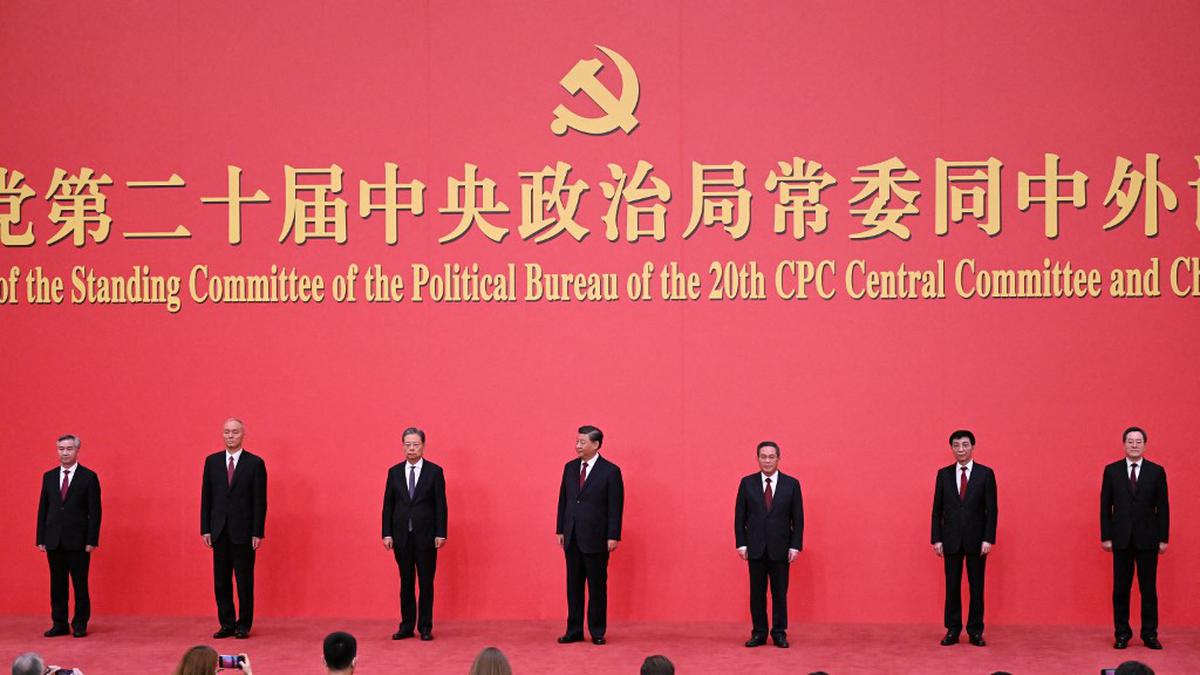
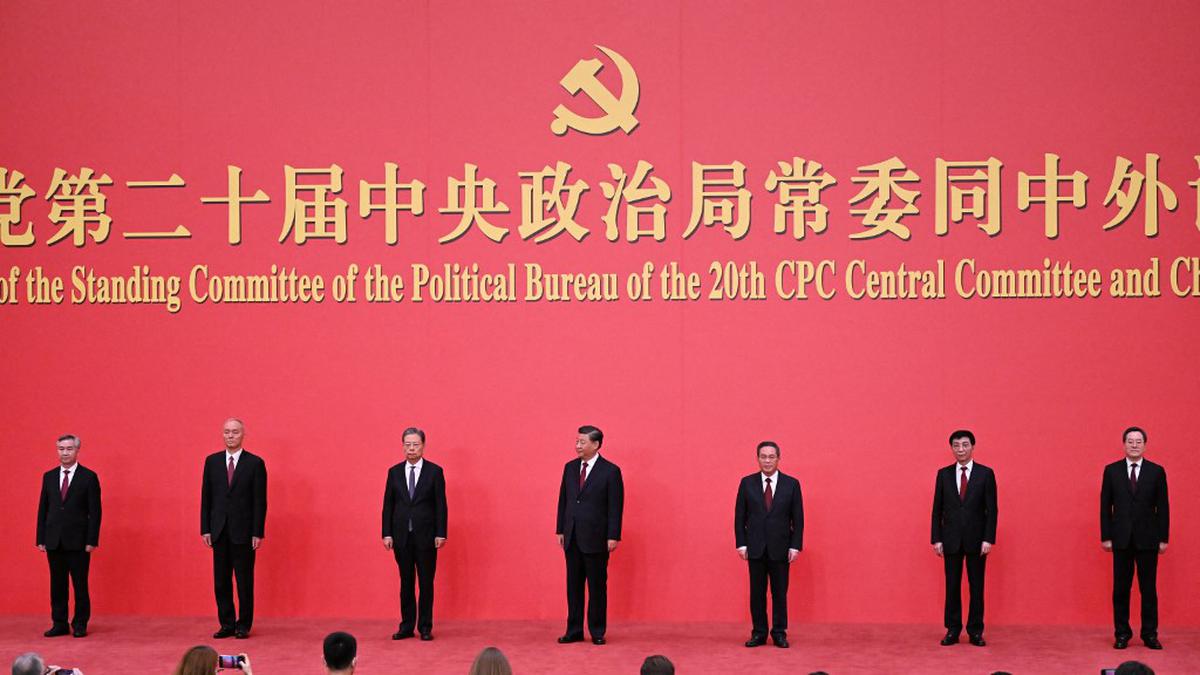
China’s President Xi Jinping and other new members of the Communist Party of China’s Politburo Standing Committee, including Li Qiang (third from right), meet the media in the Great Hall of the People in Beijing on October 23, 2022.
| Photo Credit: AFP
The story so far: On March 16, 2023, the ruling Communist Party of China (CPC) released a plan to overhaul the country’s party-state machinery, the second major restructuring of the party and government bureaucracy by President Xi Jinping. The announcement came days after the conclusion of the annual session of the National People’s Congress (NPC) in Beijing, which on March 10 formally endorsed Mr. Xi for his third five-year term. The reforms are likely to give the CPC — and Mr. Xi — even more direct control over several key areas of policy making during his third term, taking forward the trend of political centralisation seen since Mr. Xi’s coming to power in 2012.
 Also readU.K. Minister in Rwanda to reinforce migrant deportation plan
What’s driving the party-state restructuring?
According to the plan on reforming government institutions released by the CPC on March 16, newly set up party commissions will take over control of policy-making in several key sectors, previously under the domain of the State Council, which comprises various government ministries and is headed by the Premier. In China, the bureaucracy is separated by a parallel party-state structure. Government reforms in the post-Mao years sought to separate the two branches in an effort to professionalise the government bureaucracy, partly a response to the overcentralisation of party power under Mao. During this period, which also saw the introduction of what was called “collective leadership”, the Premier and the State Council grew to exercise control over policy making, particularly with regard to the economy. Mr. Xi has both disbanded the collective leadership model and diluted the power of the State Council, bringing back control over policy making to party-led commissions. A first round of party-state reforms in 2018 set up new party-led central commissions for economic reforms, foreign policy, and other areas.
What do the latest reforms entail?
The latest reforms of both the party and state bureaucracies will further move decision making out of the State Council, and are focused on two areas: tightening and unifying party control in regulating the financial sector, and bringing the party directly in charge of science and technology policy. Both have been key issues for Mr. Xi, who has criticised the “disorderly expansion” of capital by the private sector as well as expressed urgency in boosting self-reliance amid worsening relations with the U.S. and a continuing trade and technology war.
A new Central Commission for Finance will be set up “to strengthen the Central Committee’s centralised and unified leadership over financial work” which will be in charge of “top-level planning, coordination, overall advancement of financial stability and development and for supervising the work’s implementation.” Similarly, a Central Commission for Science and Technology will be tasked with “pushing forward the building of a national innovation system and structural scientific and technological reform, studying and deliberating major strategies, plans and policies for the country’s sci-tech development, and coordinating efforts to resolve major issues of strategic, guiding and fundamental significance in the sci-tech sector.” Also announced was a new Central Social Work Department, which will be tasked with strengthening party work at the “grassroots” as well as “party building work in mixed-ownership and non-public enterprises”, which will mean greater party control over the private sector. The body in charge of Hong Kong affairs, the Hong Kong and Macao Affairs Office, has also been removed from the State Council and will report to the Central Committee.
What of state-side reforms?
Besides the setting up of new party-led commissions, parallel reforms on the State Council side have also been announced. The Ministry of Science and Technology will be “restructured to better allocate resources to overcome challenges in key and core technologies, and move faster toward greater self-reliance in science and technology.” A new National Financial Regulatory Administration will be “in charge of regulating the financial industry except the securities sector”, unifying the regulatory functions of the People’s Bank of China (the central bank) and the China Banking and Insurance Regulatory Commission, which has been dissolved. A new National Data Bureau will also be established under the State Council’s top planning body, the National Development and Reform Commission (NDRC), for “coordinating the integration, sharing, development and application of data resources”. The broader goal is to unify policy making and regulation, which was earlier spread over different ministries.
[ad_2]