


• About   |
  • Advertise |
  • Contact Us
No Result
View All Result
The Second Angle (TSA Magazine)
Advertise
  • Infotainment
    • Sports
    • People
    • Inspiring
  • Entertainment
    • Lifestyle
    • Home & Decoration
  • Buzz
  • Education
  • Travel
  • Finance
  • Healthcare
  • Technology
The Second Angle
No Result
View All Result
  • Infotainment
  • Entertainment
  • Buzz
  • Education
  • Travel
  • Finance
  • Healthcare
  • Technology
Advertisement Advertisement Advertisement
ADVERTISEMENT
Home World News

G7 ministers’ meeting | India asks rich nations to scale up emission cuts

by TSA Desk
April 15, 2023
in World News
Reading Time: 4 mins read
G7 ministers’ meeting | India asks rich nations to scale up emission cuts
Share on FacebookShare on WhatsApp
Advertisement Advertisement Advertisement
ADVERTISEMENT
4 min readGAdd The Second Angle as a preferred source on Google
Key takeaways
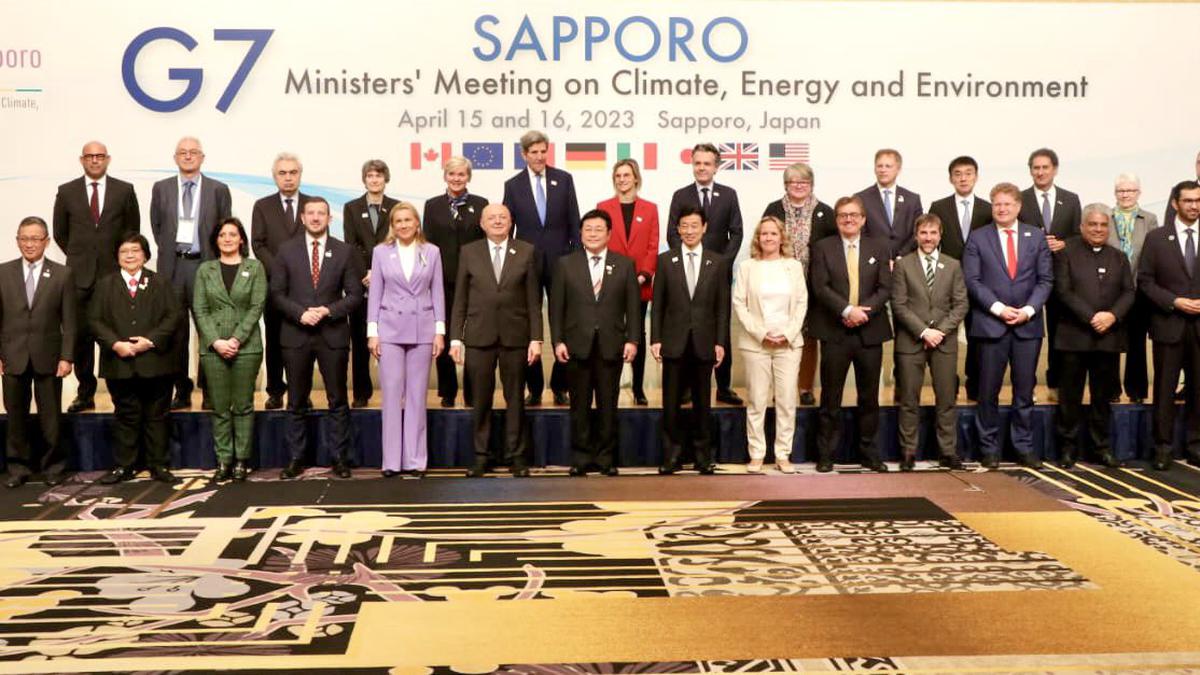
Union Environment Minister Bhupender Yadav with other ministers at the G7 Ministers Meeting on Climate Energy and Environment in Sapporo, northern Japan, on April 15, 2023.Meeting the global target of achieving net zero emissions by 2050 will require developed nations to scale up their emission reduction efforts, India said at the G7 Ministers Meeting on...This will create opportunities for developing nations like India to address the needs of its people, which will also build resilience against the adverse impacts of climate change, environmental degradation,...

[ad_1]

Union Environment Minister Bhupender Yadav with other ministers at the G7 Ministers Meeting on Climate Energy and Environment in Sapporo, northern Japan, on April 15, 2023.

Union Environment Minister Bhupender Yadav with other ministers at the G7 Ministers Meeting on Climate Energy and Environment in Sapporo, northern Japan, on April 15, 2023.
| Photo Credit: Twitter/@byadavbjp

Meeting the global target of achieving net zero emissions by 2050 will require developed nations to scale up their emission reduction efforts, India said at the G7 Ministers Meeting on Climate Energy and Environment in Japan’s Sapporo on Saturday.

In a first, Iran’s president addresses Palestinians in GazaAlso readIn a first, Iran’s president addresses Palestinians in Gaza

This will create opportunities for developing nations like India to address the needs of its people, which will also build resilience against the adverse impacts of climate change, environmental degradation, and pollution, Union Environment Minister Bhupender Yadav said at the plenary session of the G7 minister’s meeting.

He also emphasised that developing countries require access to adequate means of implementation, finance and technology to effectively combat climate change and address environmental challenges.

“The global goal of reaching net zero by 2050 needs enhanced emission descaling by developed nations. This will provide space for countries like India to achieve the development required for its people, which will provide necessary defence against the impacts of climate change, environmental degradation and pollution,” he said.

Net zero means achieving a balance between the greenhouse gases put into the atmosphere and those taken out. “IPCC AR 6 report re-emphasises that development is our first defence against climate change,” Mr. Yadav said.

“We do hope that developed countries will make good on their commitments on finance for combating climate change and provide for the same for dealing with the environmental degradation and biodiversity loss,” a statement quoting the minister said.

Mr. Yadav said while efforts have been made to establish policy frameworks to tackle climate change, it is now imperative for governments worldwide to engage individuals and promote greater public participation in the fight against climate change.

Prime Minister Narendra Modi had last year launched ‘Mission LiFE’ (lifestyle for environment) which calls for a global mass movement for inducing behavioural changes focused on “mindful and deliberate utilization” of resources.

The G-7 includes Canada, France, Germany, Italy, Japan, the United States and the United Kingdom.

During the G-7 summit in Germany last year, the participating countries established a shared objective of transitioning towards a predominantly decarbonised electricity supply by 2035.

At an event in New Delhi last month, Mr. Yadav had said that India is free to use its resources to fulfil the energy needs of its people and countries historically responsible for climate change cannot ask it to stop its development.

India firmly believes that any action to combat climate change must be based on the principles of equity and Common but Differentiated Responsibilities and Respective Capabilities (CBDR-RC).

Equity essentially means that each country’s share of carbon dioxide emissions is equal to its share of the global population.

The CBDR-RC principle recognises that each country is responsible for addressing climate change but developed countries should bear primary responsibilities as they account for most of the historical and current greenhouse gas emissions.

According to the Union Environment Ministry, India is home to 17% of the global population but accounts for only 4% of global carbon emissions.

Developed nations with the same percentage of population account for nearly 60 per cent of carbon emissions.

The Earth’s global surface temperature has risen by around 1.15 degrees Celsius as compared to the pre-industrial (1850-1900) average and the CO2 spewed into the atmosphere since the start of the industrial revolution is closely tied to it.

Major damage had already been done before the 1990s when economies like India started to develop, reports suggest.

According to the “Global Carbon Budget Report – 2022”, more than half of the world’s CO2 emissions in 2021 were from three places — China (31%), the US (14%), and the European Union (8%).

Ranking fourth, India accounted for seven per cent of global CO2 emissions.

However, at 2.4 tCO2e (tonne carbon dioxide equivalent), India’s per capita greenhouse gas emission is far below the global average of 6.3 tCO2e, according to a report released last year by the United Nations Environment Programme.

Per capita emission in the US (14 tCO2e) is far above the global average, followed by Russia (13 tCO2e), China (9.7 tCO2e), Brazil and Indonesia (about 7.5 tCO2e each), and the European Union (7.2 tCO2e).

[ad_2]

Enjoyed this story?Share it with your friends
WhatsAppLinkedInXFacebookEmail
See more TSA Mag stories on GoogleAdd us as a preferred source and our stories will show up more often in your Top Stories.
GAdd The Second Angle as a preferred source on Google
ShareSend
Tweet
Previous Post

6 Best Spy Camera Apps For Android

Next Post

US intelligence leak has not affected cooperation with partners – Blinken

Related Posts

LGBTQIA+ in Afghanistan
World News

LGBTQIA+ in Afghanistan: Life Under Taliban Rule in 2026

LGBTQIA+ in Afghanistan: the law before 2021, abuses reported under the Taliban, and the July 2025 ICC arrest warrants that...

Read moreDetails
chinese
Opinion

Boycott Chinese Products: What Changed in India Since 2020

Did the call to boycott Chinese products after Galwan work? A look at app bans, investment rules, phone sales and...

Read moreDetails
The United Kingdom, spending $800,000 to conceal Mountbatten's diaries
World News

Mountbatten Diaries Case: What the UK Tribunal Decided and Why

The Mountbatten diaries case explained: why historian Andrew Lownie went to court, what the 2022 UK tribunal ruled and what...

Read moreDetails
Top 10 Richest Men In The World: Billion Dollar Club Family
Listicles

Top 10 Richest Men in the World in 2026: Forbes List Explained

The top 10 richest men in the world in October 2026 per Forbes: Elon Musk leads at $936 billion, then...

Read moreDetails
Richest Kids in the world
Entertainment

Top 10 Richest Kids in the World and Where They Are Now (2026)

The top 10 richest kids in the world from the 2020 Kids Rich List, led by Morocco's Moulay Hassan, plus...

Read moreDetails
At least 25 killed in rebel attack on Ugandan school near Congo border
World News

At least 25 killed in rebel attack on Ugandan school near Congo border

The Allied Democratic Forces, or ADF, is accused of launching many attacks on civilians in recent years, notably on civilian...

Read moreDetails
Load More
Next Post
US intelligence leak has not affected cooperation with partners – Blinken

US intelligence leak has not affected cooperation with partners - Blinken

About

The Second Angle

The Second Angle (TSA Mag) is an infotainment and lifestyle magazine covering entertainment, travel, technology, health, education and finance.

Important Links

  • About The Second Angle
  • Advertise With Us
  • Editorial Policy
  • Privacy Policy
  • Terms and Conditions
  • Contact Us
  • Careers
  • Newsletter

Explore

  • Infotainment
  • Entertainment
  • Buzz
  • Education
  • Travel
  • Finance
  • Healthcare
  • Technology
Advertise with us

© 2017-2026. The Second Angle. All Rights Reserved. Developed and Managed by Squarebase.io

Welcome Back!

Login to your account below

Forgotten Password?

Retrieve your password

Please enter your username or email address to reset your password.

Log In
No Result
View All Result
  • Infotainment
    • Sports
    • People
    • Inspiring
  • Entertainment
    • Lifestyle
    • Home & Decoration
  • Buzz
  • Education
  • Travel
  • Finance
  • Healthcare
  • Technology

© 2017-2026. The Second Angle. All Rights Reserved. Developed and Managed by Squarebase.io

We use cookies to keep TSA fast and relevant. Read our Privacy Policy.