


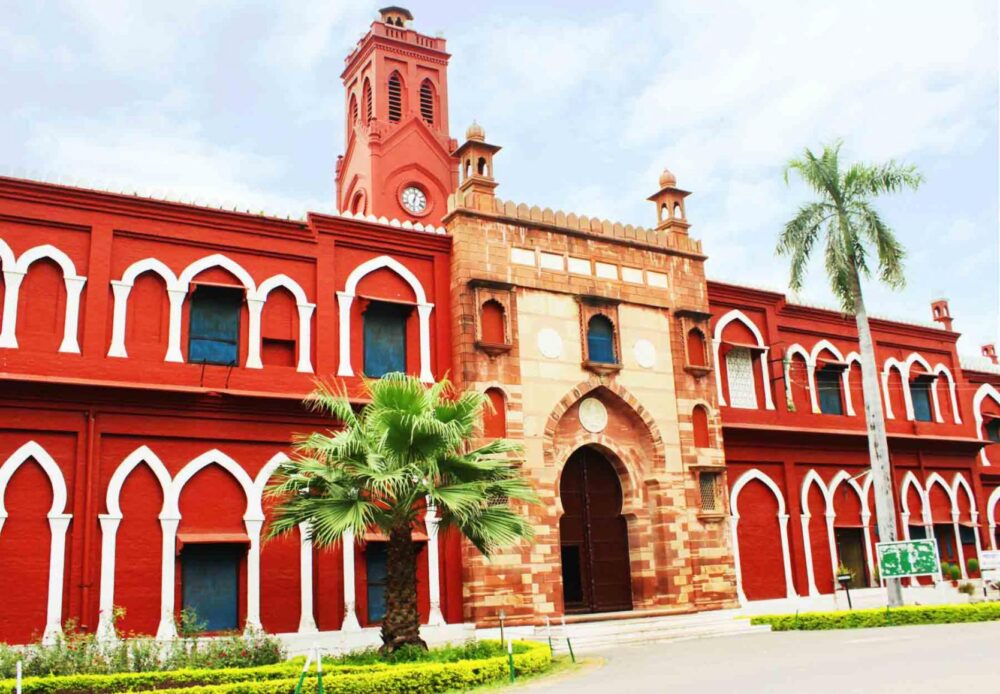

Aligarh Muslim University (AMU) is a central university funded by the Government of India, and the AMU Act, 1920 says it is open to people of every sex, race, creed, caste and class. Students of all religions study and teach there. Its separate claim to be a minority institution is still before the Supreme Court.
The question of whether AMU is “secular” comes up often in political debates and on social media. This explainer sets out what the law says, how admissions work, and where the long-running minority status case stands in 2026.
A short history of AMU
Sir Syed Ahmad Khan founded the Muhammadan Anglo-Oriental (MAO) College in Aligarh in 1875. His aim was to give Indian Muslims access to modern, English-medium education alongside traditional learning. In 1920, the AMU Act turned the college into a university.
 Also readLGBTQIA+ in Afghanistan: Life Under Taliban Rule in 2026
Funding for the college came from people of many faiths. Records of early donors include the Maharaja of Patiala, Raja Shambhu Narayan of Benares and the Maharaja of Vizianagaram, along with British officials. Among AMU’s well-known former students are hockey legend Dhyan Chand and cricketer Lala Amarnath.
What “secular” means in this debate
The word secular was added to the Preamble of the Indian Constitution in 1976. In the Indian sense, it means the state treats all religions equally and does not discriminate on the basis of faith. Article 30 of the Constitution separately gives religious and linguistic minorities the right to set up and run their own educational institutions.
So the debate around AMU is really two questions. First, is the university open to all? Second, is it legally a minority institution under Article 30? The answer to the first is clearer than the second.
Admissions and campus life
AMU admits students through its own entrance tests and, for some courses, through national tests. Admission rules are based on test performance and eligibility, not religion. The university has students from across India and from several other countries.
One point of debate is reservation. AMU has not followed the central quotas for Scheduled Castes, Scheduled Tribes and OBCs in the way most central universities do, citing its minority status claim. Critics, including some political leaders, have questioned this. Its supporters argue that the matter must wait for the courts to settle the status question.

The minority status case, step by step
| Year | What happened |
|---|---|
| 1967 | Supreme Court, in S. Azeez Basha vs Union of India, holds that AMU is not a minority institution. |
| 1981 | Parliament amends the AMU Act to reflect the university’s Muslim origins. |
| 2006 | Allahabad High Court strikes down the provision granting minority status. |
| 2016 | The Centre says it will not pursue the appeal against the High Court ruling. |
| 2019 | Supreme Court refers the issue to a seven-judge bench. |
| November 2024 | Seven-judge bench overrules the 1967 judgment by a 4:3 majority. |
What the 2024 Supreme Court ruling means
On 8 November 2024, a seven-judge bench led by then Chief Justice D.Y. Chandrachud overruled the Azeez Basha judgment. The majority held that an institution does not lose its minority character simply because it was created by a law passed by the legislature.
The bench did not declare AMU a minority institution. Instead, it set out tests to decide who established an institution and left it to a regular bench to apply them to AMU. Until that bench rules, the final status remains open.
Why the question keeps coming back
AMU’s name and history make it a frequent subject of political argument. Some leaders see the minority claim and the reservation question as signs that the university favours one community. Others, including many alumni, point to its open admissions, its mixed faculty and its long list of graduates from different faiths as proof that it serves the whole country.
Both sides often mix two separate ideas. A university can be open to all students and still be legally run as a minority institution. Several Christian, Sikh and Jain colleges in India, for example, hold minority status under Article 30 while admitting students of every religion. Whether AMU fits that model is the exact question the courts are now deciding.
Media coverage of campus protests and political statements also shapes public views. Readers should rely on court records, the AMU Act and official university notices for facts, rather than social media clips.
Where AMU stands today
In 2024, Naima Khatoon was appointed vice-chancellor, the first woman to hold the post. In the 2024 National Institutional Ranking Framework (NIRF), AMU was placed 16th overall and 8th among universities. It runs schools, colleges and centres, including the Jawaharlal Nehru Medical College and the Zakir Husain College of Engineering and Technology.
For readers, the useful takeaway is this: AMU is legally open to all, but the narrower legal question of minority status is a matter for the Supreme Court. Follow our education section for updates on admissions and rulings, and our buzz section for current affairs.
Further reading: Telegram.
Frequently asked questions
Can non-Muslim students study at AMU?
Yes. The AMU Act, 1920 opens the university to students of every religion, caste and class, and non-Muslim students and teachers are part of the campus.
Is AMU a minority institution?
This is not settled. In November 2024, the Supreme Court overruled the 1967 judgment that denied it minority status, but a regular bench will decide AMU’s actual status.
Who founded AMU?
Sir Syed Ahmad Khan founded the Muhammadan Anglo-Oriental College in 1875. It became Aligarh Muslim University under the AMU Act, 1920.
Does AMU have SC, ST and OBC reservation?
AMU has not applied the central reservation policy in the usual way, citing its minority claim. The issue is linked to the pending court decision.
Sources: Aligarh Muslim University, Wikipedia, AMU official website, Supreme Court of India.